IRAQ AT THE PRESSURE LINE
Analytical scope: This report concerns Iraq only. References to Iran, Russia, China, Türkiye or other states are included solely where documented relationships directly affect Iraqi sovereignty, security institutions, telecommunications, finance, armed groups or critical infrastructure. The Iron Triangle in this analytical framework remains China, Russia and Iran. Iraq is not a fourth side of that triangle; it is examined as a state exposed to external pressure from several competing powers.
PART I: THE POST-SADDAM STATE, COURTS, EXECUTIONS, SECURITY FORCES, WOMEN, MINORITIES AND THE UNRESOLVED LEGACY OF IMPUNITY
Iraq After Saddam Hussein: A State Rebuilt Without Fully Resolving the Question of Power
Iraq's political order after 2003 cannot accurately be described as one continuous "regime." It has consisted of successive governments, elected institutions, federal security agencies, the Kurdistan Regional Government, political parties and powerful armed organizations, some of which operate inside or alongside formal state structures.
That distinction is important because abuses in Iraq do not originate from one institution.
The contemporary accountability problem is fragmented across police units, intelligence bodies, prisons, courts, federal security forces, the Popular Mobilization Forces, armed factions, political networks and institutions controlled by competing parties.
Human Rights Watch reported that Iraq retained relative national stability during 2025, but that restrictions on civic space, impunity for abuses by state-affiliated armed groups and security forces, weak public services and discriminatory legislation remained major concerns. During Iraq's January 2025 Universal Periodic Review at the UN Human Rights Council, states raised concerns about unfair trials, the death penalty, restrictions on expression and assembly and impunity for serious violations.Human Rights Watch
Amnesty International's 2025 review similarly described security forces, militias and political actors as continuing to commit serious human-rights violations with near-total impunity, while authorities increasingly used arrests, legal harassment and public-morality regulations against journalists, activists and critics.Amnesty International
The Death Penalty: More Than 8,000 People Under Sentence of Death
Iraq remained one of the states that retained and used capital punishment.
Amnesty International's global death-penalty report, published in May 2026, recorded at least 79 new death sentences in Iraq during 2025, down from 200 recorded during 2024. These included 27 sentences under anti-terrorism legislation, 35 for drug offences, 13 for murder and one for genocide. Three women were among those sentenced to death.Amnesty International USA
Most importantly, Amnesty estimated that more than 8,000 people remained under sentence of death in Iraq at the end of 2025. That is the best recent independently published baseline available entering 2026.Amnesty International
A precise nationwide figure for September 2026 is not publicly available.
Therefore, this report does not invent an exact current death-row total.
The defensible conclusion is that Iraq entered 2026 with 8,000 or more people under sentence of death, while new sentencing continued and case reviews introduced by the General Amnesty Law complicated the picture.
The General Amnesty Law Changed the Execution Environment
On January 21, 2025, parliament amended Iraq's General Amnesty Law.
The amendment allows judicial review of some terrorism-related convictions where evidence involved coerced confessions, statements from anonymous informants or third-party confessions. Amnesty International reported that executions were consequently largely paused during 2025, although it received credible reports of secret executions that it could not independently corroborate through official records.Amnesty International USA
This is significant because terrorism prosecutions have long been one of the most controversial components of the Iraqi justice system.
The problem is not merely the legal existence of capital punishment.
It is the combination of capital punishment with allegations of coerced confession, inadequate defense access, opaque proceedings and broad anti-terrorism statutes.
Protest Repression Did Not End With the Tishreen Era
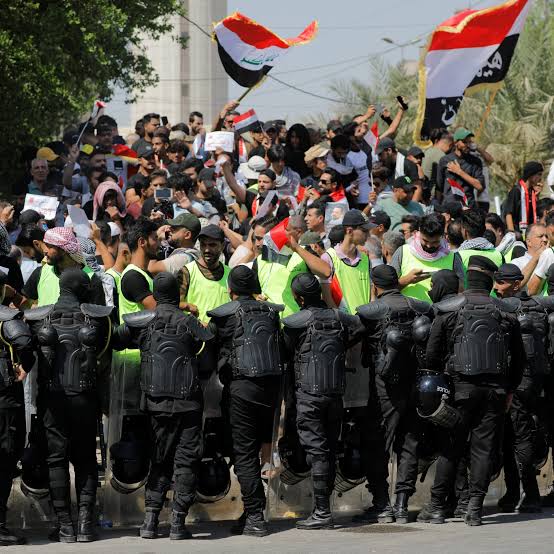
The mass Tishreen protest movement of 2019 remains central to understanding present-day Iraqi political repression because hundreds of protesters were killed and thousands injured, while accountability for many attacks remained incomplete.
But new protest-related abuses continued in 2026.
Amnesty International reported that during June and July 2026, peaceful protesters in the southern city of al-Kut, demonstrating against electricity failures and demanding basic services, were subjected to unlawful force and detention by Iraqi security forces.Amnesty International
The same report highlighted continued intimidation of journalists, human-rights defenders and activists.
This means that although Iraq has not experienced a new nationwide uprising comparable in scale to Tishreen during the 2025 to September 2026 reporting period, the underlying conflict over public services, corruption, political accountability and armed power remains unresolved.
Assassination and Intimidation of Civil-Society Figures
The first half of 2026 produced disturbing new attacks on civic actors.
Amnesty reported that women's-rights activist Yanar Mohammed was assassinated in Baghdad on March 2, 2026. Authorities announced an investigation, but Amnesty stated in August that no meaningful public information about its progress had been released.
Another activist survived an attempted killing in Babil governorate on April 21.Amnesty International
These incidents matter beyond the individual victims.
When assassinations occur alongside dormant arrest warrants, vague morality prosecutions, media restrictions and armed-group impunity, a chilling effect develops without the government needing formally to prohibit every organization.
Death in Police Drug Custody
Human Rights Watch reported another serious incident in August 2026 involving a man who died in the custody of an Iraqi police drug-control unit.
The case raised questions about custodial abuse, torture allegations, medical treatment and accountability inside anti-narcotics policing.Human Rights Watch
Drug enforcement therefore deserves scrutiny not only as a criminal-law issue but as a human-rights and detention issue.
Women and Girls: A Legal Backslide
The legal position of Iraqi women deteriorated during this period.
Amendments to Iraq's Personal Status Code adopted in August 2025, drawing on Jaafari Shia jurisprudence, continued to concern human-rights organizations because of their implications for equality in marriage, divorce, inheritance and child protection. Amnesty stated in August 2026 that the amendments continued to undermine equality for women and girls.Amnesty International
The controversy had begun earlier because proposals could allow religious authorities to exercise greater authority over family law and facilitate marriages involving girls below the previous legal standard. Amnesty had warned that some formulations could permit marriages involving girls as young as nine.Amnesty International USA
Iraq still lacked comprehensive national domestic-violence legislation in 2026.
Its penal code also retained provisions criticized for allowing husbands to discipline wives, parents to discipline children and courts to mitigate punishment in killings committed for so-called "honorable motives."Human Rights Watch
Minorities: Christians, Yazidis, Turkmen, Shabak and Others
Iraq's minorities remain affected by a mixture of post-ISIS insecurity, displacement, property disputes, militia influence and political underrepresentation.
On April 1, 2025, an attack targeted Assyrian Christians celebrating Akitu, the Assyrian-Babylonian New Year, in Duhok. Two people were seriously injured. UNAMI condemned the attack and emphasized protection of Iraq's religious and ethnic diversity.The United Nations in Iraq
Yazidi communities continue to confront the legacy of ISIS genocide, missing persons, destroyed communities, displacement and insecurity around Sinjar.
The security complexity is compounded by the presence of competing forces and political actors in and around minority territories.
For Iraq's minorities, the issue is therefore not one single persecuting institution.
It is frequently the absence of one trusted state authority capable of providing security, justice, property protection and equal citizenship.
LGBT Iraqis and Digitally Enabled Persecution
Iraq's 2024 amendment to the anti-prostitution law remained operative during 2025 and 2026.
It imposes prison sentences of 10 to 15 years for same-sex relations, additional punishment for gender-affirming medical interventions and penalties for what the law describes as promoting homosexuality.
Human Rights Watch continued documenting digital targeting, abduction, violence, torture and sexual violence against LGBT people, including abuse by armed groups and use of morality provisions by authorities.Human Rights Watch
This is particularly relevant to the digital-control component of this report because online identification can be converted directly into physical vulnerability.
PART II: INTERNET SHUTDOWNS, NETWORK CONTROL, DPI, BACKBONES AND THE PHYSICAL GEOGRAPHY OF IRAQ'S DIGITAL SOVEREIGNTY
Iraq's Digital-Control Model Is Not the Iranian, Chinese or Russian Model
The Iraqi internet should not be described by copying technical claims from reports on Iran, China or Russia.
Open-source evidence does not establish that Iraq operates a Great Firewall comparable to China's or a national TSPU architecture comparable to Russia's.
Instead, Iraq has demonstrated an ability to impose centrally ordered nationwide shutdowns, while its telecommunications system increasingly concentrates traffic through state-controlled national backbones.
This distinction is critical.
A government does not need highly sophisticated DPI to shut down the internet if it can instruct major upstream operators to suspend connectivity.
Twenty-Seven Shutdowns in Twelve Months
Internet Society Pulse recorded 27 shutdowns in Iraq during the preceding twelve months by August 2026 and 184 shutdown events since 2019.
Many of the 2026 shutdowns were ordered during school examinations.Internet Society Pulse
On May 19, 2026, Iraq's communications minister publicly announced that internet access would be suspended between 6:00 and 7:30 a.m. during national examinations.INA
Internet Society measured further shutdowns in August 2026 lasting approximately 50 minutes.
A technical monitoring study published in September found 25 mornings between June 2 and September 10, 2026 when roughly 66 to 69 percent of Iraqi connectivity disappeared at approximately the same hour, then recovered.GeoCables
The repetitiveness is technically important.
It demonstrates administrative capability to affect a large proportion of the national network on command.
Shutdown Capability Is Itself a Security Architecture
A network that can lose two-thirds of national connectivity at a scheduled time has central coordination points.
The relevant forensic question is not merely:
"Which website is blocked?"
It is:
Which backbone, exchange, upstream provider, gateway or routing-control mechanism makes simultaneous national disruption possible?
The most likely technical mechanisms for a scheduled national interruption include BGP route withdrawal, upstream transit suspension, centralized filtering or gateway-level traffic interruption.
Public measurement alone does not prove which mechanism Iraq uses in every shutdown.
Packet captures, BGP announcements, provider logs and backbone configuration records would be needed for precise attribution.
DPI: What Can Be Established
Deep Packet Inspection can classify traffic using information including:
Source and destination IP addresses, ports, DNS requests, TLS handshake characteristics, Server Name Indication, protocol fingerprints, UDP and QUIC behavior, packet timing, packet sizes and known proxy infrastructure.
A DPI device can then impose actions such as blocking, throttling, resetting connections or applying service-specific policy.
Iraq possesses backbone infrastructure technically capable of supporting sophisticated traffic-management functions.
However, the currently available 2025 and 2026 open-source evidence does not justify claiming that Iraq uses a specific named DPI appliance nationwide to detect WireGuard, OpenVPN or other encrypted protocols.
That evidence gap should be preserved rather than filled with speculation.
Three Major State Backbone Systems
An unusually important disclosure came from Iraq's Ministry of Communications in February 2025.
Communications Minister Hiyam Al-Yasiri stated that Iraq operates three major state-owned national backbone systems:
SEN Backbone, Huawei Backbone and Nokia Backbone.
She described them as extending across Iraq and being provided by the state for use by the private sector.Nina News
This is directly relevant to the question of foreign technology.
Chinese Huawei and European Nokia technology are therefore not theoretical presences inside Iraq's telecommunications environment.
They are openly identified by Iraq's communications ministry as components of state-owned backbone infrastructure.
Nokia Hardware Inside Iraqi Networks
Nokia separately documented deployment of its equipment through Iraqi operator Earthlink.
The company's published technical description identifies equipment including:
Nokia 7750 Service Router systems, Nokia 7250 Interconnect Routers and Nokia Network Services Platform management technology.Nokia Corporation | Nokia
In October 2025, Gulf Bridge International also selected Nokia's 1830 Global Express optical platform for a new high-capacity route running through Iraq and linking Europe, the Middle East and Asia.Nokia Corporation | Nokia
These are concrete hardware footprints.
They do not prove that Nokia knowingly provided censorship functionality.
That distinction is indispensable.
Telecommunications routing equipment is dual-use infrastructure.
Responsibility for censorship requires evidence connecting equipment configuration, operator policy and government orders.
Huawei's Presence
The Iraqi government itself identifies a Huawei Backbone as one of its three large backbone networks.Nina News
This establishes Chinese-origin technology inside Iraq's national telecommunications environment.
It does not establish which Huawei router models are deployed at each site, whether DPI capabilities are active or whether Huawei personnel participate in censorship decisions.
Those are separate questions requiring procurement documentation, configuration files, serial numbers and technical inspection.
Hardware Serial-Number Investigation
For future forensic investigation, the strongest evidence would include:
Manufacturer, exact model, chassis serial number, line-card serial number, MAC address, OUI, firmware version, software image, hardware revision, manufacturing date, importer, distributor and installation location.
Those identifiers can then be cross-checked with:
Purchase orders, invoices, warranty databases, distributor files, customs declarations, bills of lading, export licenses, freight-forwarder records and maintenance contracts.
The purpose is not merely to identify Western or Asian hardware.
It is to reconstruct the chain:
Manufacturer, distributor, intermediary, importer, Iraqi operator, installation site, configuration, government access.
Iraq Is Becoming a Transit Corridor Between Asia and Europe
Iraq's network geography is changing.
In January 2025, the Ministry of Communications announced an agreement involving IQ Networks and Gulf Bridge International to use dark-fiber technology for international transit across Iraq.INA
By late 2025, GBI and Nokia were building a high-capacity terrestrial route intended to strengthen Europe-Asia connectivity through Iraqi territory.Nokia Corporation | Nokia
This creates economic opportunity but also strategic sensitivity.
When a country becomes an international transit corridor, its infrastructure may carry traffic that does not originate or terminate domestically.
That makes governance, lawful interception, cybersecurity and physical protection of backbone routes more important to European and Asian customers as well.
Border Stations and Interception: What Is Not Yet Proven
Iraq connects physically with international networks through routes toward Türkiye, Iran, the Gulf and other regional systems, together with subsea connectivity entering the Gulf.
But public evidence reviewed for this report does not identify a verified list of military or intelligence interception rooms at particular Iraqi border stations.
It would therefore be irresponsible to claim that an IRGC, Iraqi intelligence service or foreign military directly operates a named DPI rack at a particular border facility without documentation.
Exact attribution would require:
Network diagrams, building plans, telecom-engineer testimony, photographs, maintenance documentation, equipment serial numbers or configuration files.
This remains an important field for further investigation.
PART III: THE ECONOMIC COST, OIL AND BANKING NETWORKS, MILITIA FINANCE, CRYPTO-FORENSICS AND THE FOREIGN TECHNOLOGY SUPPLY CHAIN
Internet Shutdowns Now Strike an Economy That Is Rapidly Digitizing
Iraq's digital economy is expanding.
The Central Bank of Iraq stated in August 2025 that development of electronic-payment systems had become a strategic element of economic modernization.
Its systems include 24-hour real-time gross settlement, electronic clearing, a national retail-payment switch, mobile payment, government payment gateways and a proposed national card scheme.البنك المركزي
Fifty-six banks and thirteen electronic-payment companies were participating in the national retail infrastructure described by the Central Bank in 2025.البنك المركزي
That matters because every additional digital service increases the economic cost of national connectivity interruptions.
There Is No Audited Quarterly E-Commerce Loss Dataset
The requested exact quarterly losses cannot responsibly be produced from available public evidence.
No Central Bank of Iraq, World Bank, IMF, Internet Society or other authoritative dataset reviewed for this report provides audited figures stating:
Q1 2026 censorship losses, Q2 2026 censorship losses, Q3 2026 censorship losses and Q4 2026 censorship losses.
Therefore this report does not invent those figures.
A credible quarterly calculation would need:
Merchant transaction volume, failed payment authorizations, POS traffic, mobile-wallet transfers, online-retail turnover, banking outages, delivery-platform transactions and operator revenue by hour.
Without those datasets, exact national losses would create false precision.
A June 2026 Iraqi human-rights organization nevertheless warned publicly that recurring examination shutdowns were creating substantial economic losses across sectors dependent on digital services.شفق نيوز..
The Wider Economy Entered a Severe 2026 Shock
Iraq's economic vulnerability is not attributable to internet policy alone.
On September 24, 2026, the European Bank for Reconstruction and Development projected an extraordinary 12 percent contraction in Iraq's economy for 2026, linked largely to conflict-related reductions in oil exports and regional disruption.Reuters
This distinction matters.
Internet interruptions impose additional costs on a country already exposed to oil dependence, infrastructure deficiencies, war-related disruption and political instability.
It would be analytically wrong to attribute the national contraction to digital censorship.
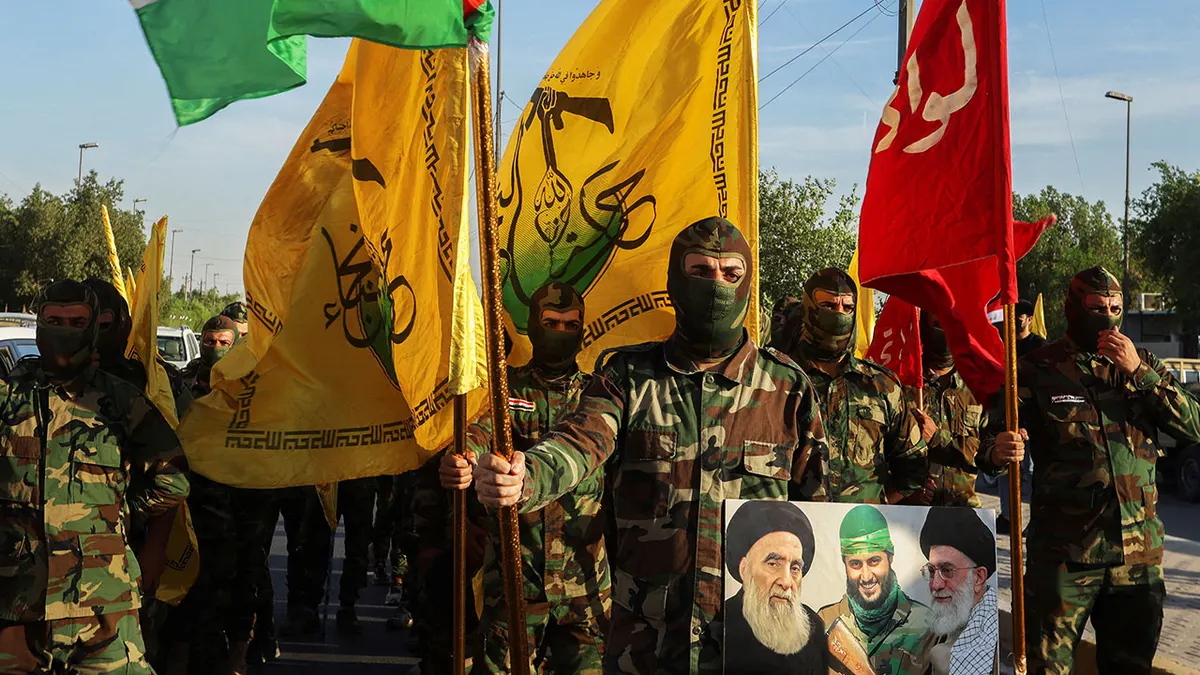
Iran-Backed Armed Groups Inside the Iraqi State Environment
The most consequential foreign-influence issue in contemporary Iraq concerns Iran and Iran-aligned armed organizations.
The U.S. Treasury designated seven Iraqi militia commanders in April 2026 from groups including Kata'ib Hezbollah, Kata'ib Sayyid al-Shuhada, Harakat al-Nujaba and Asa'ib Ahl al-Haq, alleging that they planned or directed attacks against U.S. personnel and interests.U.S. Department of the Treasury
These designations represent U.S. government findings and sanctions actions, not neutral judicial determinations by an international court.
Nevertheless, they provide concrete documentary evidence of the American government's assessment that these groups are supported by Iran and threaten Iraqi sovereignty and U.S. personnel.
Intelligence Collection for the IRGC
A particularly important Treasury action described activity beyond ordinary militia financing.
Treasury stated that in early 2025 Kata'ib Hezbollah and IRGC officials coordinated operations targeting U.S. interests in Iraq.
According to Treasury, Baghdad-based Kata'ib Hezbollah figure Hasan Qahtan Al-Sa'idi operated a source network gathering information on U.S. forces and presence in Iraq on behalf of the IRGC. Treasury said the network included individuals associated with the Popular Mobilization Forces.U.S. Department of the Treasury
This is directly relevant to concerns about institutional penetration.
It demonstrates a documented U.S. allegation that individuals associated with an Iraqi armed structure gathered intelligence for an Iranian state organization.
That is stronger evidence than generalized claims about foreign visitors, refugees or students.
Iraqi Banking and Militia Finance
Treasury has also accused Iraqi banking executives of providing financial services to the IRGC-Qods Force, Kata'ib Hezbollah and Asa'ib Ahl al-Haq.
Its 2025 action alleged that commercial banking positions were used to obtain U.S. dollars, launder money through false receipts and move militia wealth outside Iraq.U.S. Department of the Treasury
The security significance is substantial because financial penetration can transform ordinary banking infrastructure into a sanctions-evasion mechanism.
The investigative chain should therefore examine:
Bank ownership, beneficial owners, correspondent accounts, U.S.-dollar purchases, trade invoices, shell companies, customs declarations and militia-linked counterparties.
Oil Diversion and Armed-Group Revenue
In May 2026, the U.S. Treasury sanctioned an Iraqi deputy oil minister and other figures, alleging that Iraq's oil sector had been exploited to divert revenue for Iran and Iran-aligned militias.
Treasury also alleged that a senior Kata'ib Sayyid al-Shuhada figure had coordinated millions of dollars in payments to Lebanese Hezbollah personnel connected with weapons procurement.U.S. Department of the Treasury
Again, these are U.S. government allegations made in sanctions actions.
They nevertheless demonstrate why oil trading, shipping documentation and beneficial ownership need to be examined alongside conventional militia finance.
$2.6 Billion in Iraqi Government Funding to the PMF
A September 2026 Treasury action provides an even more politically sensitive figure.
Treasury stated that the Popular Mobilization Forces receive more than $2.6 billion annually from the Iraqi government and alleged that Kata'ib Hezbollah holds influential leadership positions within the PMF structure, including intelligence, missiles, anti-armor and special-forces directorates.U.S. Department of the Treasury
This does not mean the entire PMF is controlled by Kata'ib Hezbollah or Iran.
The PMF contains numerous factions with different loyalties and structures.
But the alleged location of an Iran-aligned organization inside a state-funded security umbrella creates an unusually complex sovereignty problem.
Qassem Soleimani and the Historical Iranian Footprint
The Iranian footprint in post-2003 Iraq predates 2025.
IRGC-Quds Force commander Qassem Soleimani, killed in a U.S. strike near Baghdad International Airport in January 2020, had for years played a major role in Iran's relationships with Iraqi armed groups and political actors.
His role is historical context, not evidence by itself for every current Iraqi institution.
The stronger contemporary evidence lies in the 2025 and 2026 Treasury actions documenting alleged IRGC relationships with individual Iraqi militia leaders, banks, intelligence collectors and weapons-procurement networks.
U.S. Withdrawal and a New Security Vacuum
The latest major development came on September 29, 2026.
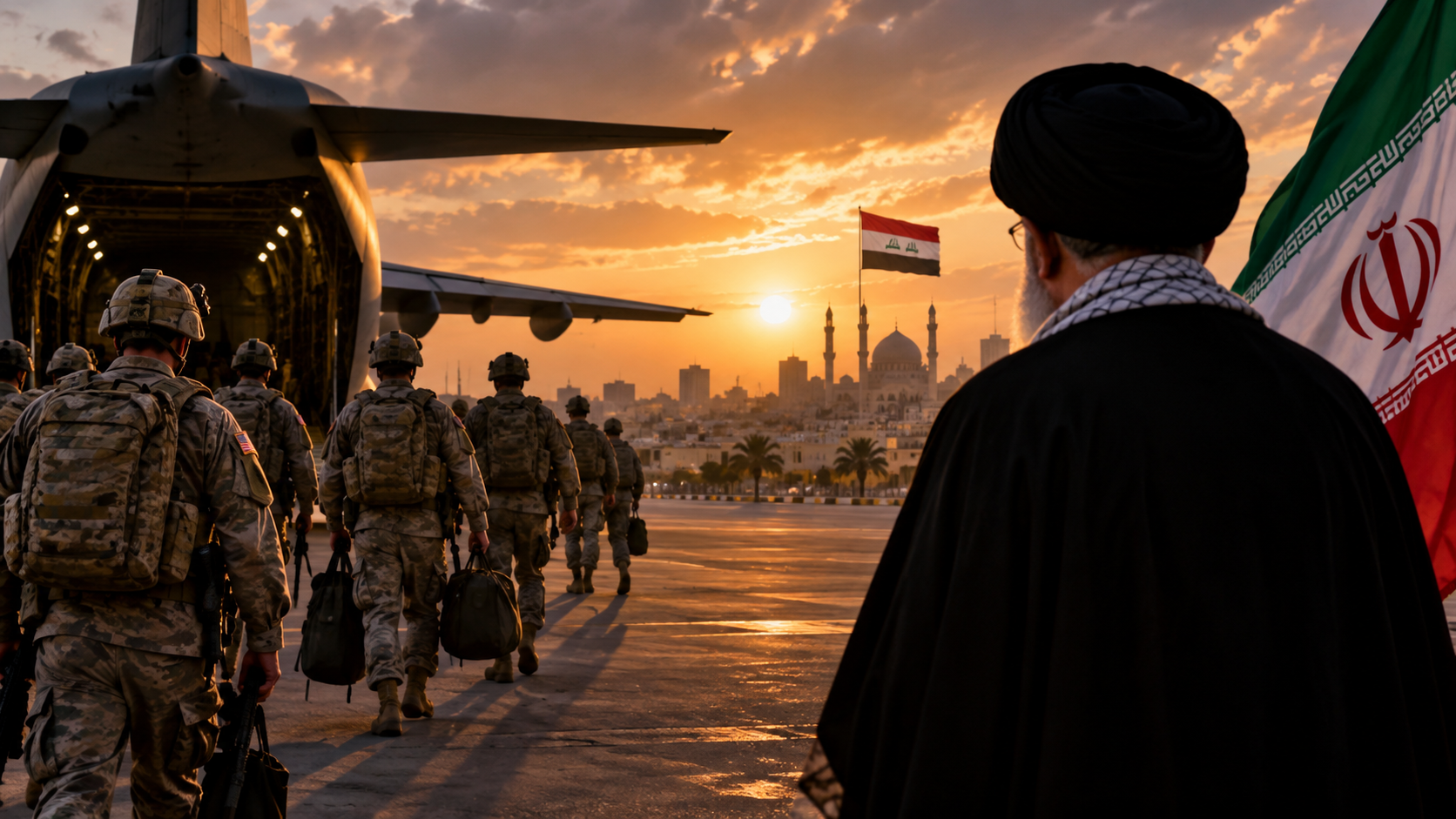
Reuters reported that U.S. forces were scheduled to complete their withdrawal from Iraq by September 30, ending more than two decades of continuous military presence.
Iran and allied Iraqi militias portrayed the departure as a strategic victory, while Iraqi and regional officials expressed concerns about the ability of Iraqi forces to contain Islamic State remnants and increased Iranian influence.Reuters
This creates a different security environment.
The question after withdrawal is not simply whether Iraq can defeat ISIS tactically.
It is whether the Iraqi state can maintain autonomous command over armed institutions while powerful factions maintain independent relationships with foreign governments.
Türkiye Also Maintains a Military Footprint
Iran is not the only foreign state whose security presence has affected Iraqi sovereignty.
Türkiye maintained forces in northern Iraq, principally in connection with operations against the PKK.
On September 23, 2026, Türkiye and Iraq agreed to gradually transfer the Bashiqa-Zelikan military camp near Mosul to Iraqi authorities, with the withdrawal expected to conclude by the end of 2026.Reuters
This is important because Iraqi sovereignty is pressured from multiple directions, not by one external actor alone.
China and Russia: Different Forms of Influence
China and Russia have important relationships with Iraq, but the evidence differs substantially from Iran's militia relationships.
China's most visible role includes energy, infrastructure, telecommunications and commercial activity.
Russia's footprint includes energy, arms and historical defense relationships.
There is not equivalent 2025 to 2026 open-source evidence demonstrating that Russia or China exercise the same degree of direct militia penetration attributed by U.S. authorities to Iran.
The Iron Triangle concept therefore should not erase differences between its three states.
In Iraq:
Iran has the most directly documented militia and political-security relationships; China has major commercial and infrastructure links; Russia has defense, energy and geopolitical relationships.
Crypto-Forensics
The user requested investigation of cryptocurrency wallets linked to Iraqi security organizations and militias.
The public evidence remains incomplete.
The strongest recent crypto evidence concerns the wider IRGC financial ecosystem rather than a definitive public list of Kata'ib Hezbollah-controlled TRON addresses.
A September 2026 U.S. Senate investigation reported that 84 percent of 846 wallets sanctioned by U.S. or Israeli authorities in connection with Iranian networks had interacted with USDT, while Tether said it froze nearly $550 million in Iran-linked USDT during 2026.Reuters
Israel's National Bureau for Counter Terror Financing separately announced sanctions in July 2026 against 37 digital wallets it attributed to an IRGC financing infrastructure used to transfer funds to regional armed organizations.NBC TF
Those findings demonstrate that cryptocurrency is relevant to the financial ecosystem surrounding Iranian regional networks.
They do not automatically prove that every listed wallet belongs to an Iraqi militia.
ISIS and Virtual Assets
Another Iraqi crypto-finance problem concerns ISIS.
A March 2026 U.S. Treasury Inspector General report stated that ISIS retained an estimated $10 million in reserves, with some funds transferred from Iraq and Syria through virtual assets to globally dispersed offices.
Treasury said supporters had historically used unhosted wallets, cryptocurrency exchanges and crypto ATMs.Office of Inspector General
This creates two different crypto-forensic targets in the Iraqi environment:
Iran-aligned armed-group finance and ISIS-linked virtual-asset networks.
They should not be merged into one category.
PART IV: IRAQ BETWEEN FOREIGN POWERS, TRANSNATIONAL THREATS, EUROPEAN AND AMERICAN SECURITY, HUMANIZING BLACKOUTS AND THE QUESTION OF STATE SOVEREIGNTY
Iraq Is Not a Passive Battlefield
It is tempting to describe Iraq solely as territory contested by Iran, the United States, Türkiye, Russia and China.
That would understate Iraqi agency.
Iraq has its own elected government, military institutions, ministries, courts, businesses and civil society.
But its post-2003 institutional structure has repeatedly allowed external competition to intersect with domestic political divisions.
The security question is therefore not whether foreign governments have relationships inside Iraq.
All major states do.
The critical question is whether those relationships override Iraqi law, Iraqi command authority or Iraqi public interests.
Iran's Position Is Structurally Different
Among external actors, Iran occupies a distinctive position because several Iraqi armed factions have formal or ideological relationships with the IRGC-Quds Force.
The April, May and September 2026 Treasury actions describe alleged networks involving weapons transfers, intelligence gathering, oil revenue, banking and militia command.U.S. Department of the Treasury
That does not prove that the entire Iraqi government acts on Tehran's instructions.
It does demonstrate a persistent sovereignty problem when armed groups participate in Iraqi state structures while maintaining independent relationships with a foreign military organization.
A Direct Threat to the United States
The security implications are no longer confined to Iraqi territory.
Treasury stated in September 2026 that a senior Kata'ib Hezbollah commander had been arrested in connection with an alleged attempt to arrange the bombing of a New York synagogue and other Jewish institutions in Los Angeles and Scottsdale.U.S. Department of the Treasury
That allegation remains subject to criminal proceedings.
But if established, it would illustrate how an Iraqi armed network linked by U.S. authorities to Iran can generate a security threat inside the United States.
This is precisely why financial, intelligence and travel networks originating in Iraq matter to Western security agencies.
Europe Faces a Different Iraqi Exposure
Europe's vulnerabilities are somewhat different.
They include:
Terrorist financing, illicit arms movement, sanctions evasion, migrant smuggling, organized crime, cybercrime, energy exposure, money laundering and misuse of European corporate structures.
Europe also receives Iraqi political refugees, journalists, minorities and activists who may be threatened by non-state actors.
The proper response is not to treat Iraqi migrants or students as intelligence risks.
Counterintelligence analysis requires evidence of operational relationships, financing, tasking or criminal conduct.
The Wrong Way to Investigate Foreign Influence
Claims that Iran, Russia or China routinely insert agents into Western or Iraqi institutions disguised as students, tourists, refugees or businessmen require case-specific proof.
Nationality, immigration category or academic status is not evidence of intelligence affiliation.
A credible investigation looks for:
Handler communications, unexplained financing, covert tasking, false identities, undeclared government relationships, procurement activity, intelligence collection or operational support.
The Treasury's 2025 description of a Kata'ib Hezbollah source network collecting information for the IRGC is an example of the type of evidence that matters.U.S. Department of the Treasury
Humanizing Iraq's Internet Shutdowns
Iraq's recurring shutdowns have frequently been justified as a mechanism to prevent cheating during school examinations.
But the network does not know why an individual needs connectivity.
When two-thirds of connectivity disappears, the impact can reach:
Hospitals, pharmacies, laboratories, banking systems, payment terminals, cloud services, transportation platforms, journalists, emergency communication, government portals and businesses.
A person waiting for a bank authorization, diagnostic image, prescription verification or urgent message experiences the same network interruption as a student sitting an examination.
Internet Society's record of repeated shutdowns demonstrates that the problem is systematic rather than exceptional.Internet Society Pulse
Can Shutdowns Cause Death?
Digital disruption can increase medical risk.
Hospitals increasingly depend on scheduling, laboratory communication, imaging systems, electronic records, specialist consultation and payment authorization.
But a claim that a particular Iraqi shutdown directly caused specific deaths requires patient-level medical evidence.
No reliable national dataset reviewed for this report provides such a death count for 2025 or 2026.
The responsible conclusion is that shutdowns can endanger patients and disrupt care, while direct mortality attribution must be established case by case.
Sensitive Patient and Service Data
The risk posed by outsourced digital services is broader than Iraq.
Hospitals, banks, governments and contractors increasingly use external providers for interpretation, IT support, identity verification and cloud services.
If an Iraqi, American or European government employee uses such a service, sensitive information may pass through external systems.
The relevant counterintelligence questions are:
Who owns the provider, where are the servers, where are employees physically located, which subcontractors have access, what data are recorded, how long are records retained and which governments can legally compel disclosure?
There is no reliable evidence reviewed for this Iraq report demonstrating that Iraqi security services operate a systematic foreign medical-interpretation espionage program.
Such a claim should therefore not be inserted as fact.
Media Influence and Political Information
The same standard applies to allegations concerning Western media organizations.
A foreign government can attempt covert influence through financing, lobbying, intermediaries, cyber operations or information campaigns.
However, there is no credible evidence reviewed for this Iraq-focused report establishing that Iran, Iraq, Russia or China controls the editorial policy of VOA Persian.
Any allegation involving a particular media organization should be supported by financial records, communications, editorial directives or other evidence.
Political disagreement or perceived editorial bias alone is not proof of foreign intelligence control.
Money Transfers to Europe and America
Iraq remains integrated into international banking despite sanctions and compliance concerns.
The most important risk areas include:
False trade invoices, currency arbitrage, shell companies, correspondent banking, oil transactions, exchange houses, cash couriers, informal money transfer, cryptocurrency and beneficial-ownership opacity.
U.S. Treasury designations involving Iraqi banks and Iran-aligned militias demonstrate that these vulnerabilities are not hypothetical.U.S. Department of the Treasury
But it would be inaccurate to say that U.S. authorities have completely failed to stop such flows.
Sanctions, designations, correspondent-bank controls and criminal enforcement have disrupted networks.
The stronger conclusion is that financial enforcement remains incomplete because networks adapt.
The Iron Triangle and Iraq
The analytical Iron Triangle remains:
China, Russia, Iran.
Iraq is outside the triangle.
Its relationship with each vertex is different.
Iran: the strongest documented militia, intelligence, banking and political-security penetration.
China: infrastructure, telecom, commercial and energy engagement, including Chinese equipment inside Iraq's telecommunications system.
Russia: defense, energy and geopolitical relationships.
The danger of collapsing these relationships into one unified conspiracy is that it hides the actual mechanisms.
The evidence is more useful when broken into specific channels.
The September 2026 Strategic Turning Point
The most important development at the end of this reporting period is the withdrawal of U.S. forces.
Reuters reported on September 29 that the withdrawal was about to be completed, while Iran-aligned groups celebrated it and Iraqi officials confronted concerns over ISIS cells and the future balance of power.Reuters
At almost the same moment, Iraq was negotiating the transfer of a Turkish military base back to Iraqi authority.Reuters
These developments make late 2026 a sovereignty test.
The core question is whether Iraq can replace foreign military presence with stronger national command, or whether the vacuum will instead increase the autonomy of armed organizations tied to outside powers.
Final Assessment
Iraq's central crisis in 2025 and 2026 is not best described simply as dictatorship, terrorism or foreign occupation.
It is a competition over sovereignty.
The state possesses functioning ministries, courts, elections, security forces and expanding digital infrastructure.
At the same time, thousands remain under death sentences; fair-trial concerns continue; women face legal regression; activists and journalists encounter intimidation and violence; minority communities remain insecure; recurring government-ordered internet shutdowns affect national connectivity; and armed factions with foreign relationships continue operating near or inside state structures.Amnesty International
The telecommunications environment deserves particular scrutiny because Iraq is becoming both a digital economy and an international transit corridor.
The country's own communications ministry identifies Huawei, Nokia and SEN national backbone systems, while new GBI infrastructure is increasing Iraq's role in Europe-Asia connectivity.Nina News
The financial investigation is equally important.
Iraq's oil system, commercial banks, militia financing and emerging crypto environment intersect with international sanctions policy and Iranian regional networks.U.S. Department of the Treasury
For Europe and the United States, the risk is therefore not one dramatic conspiracy.
It is the convergence of identifiable vulnerabilities:
Militia autonomy, foreign intelligence relationships, weapons networks, illicit finance, sanctions evasion, strategic telecommunications infrastructure, energy dependence and incomplete judicial accountability.
The next investigative stage should follow specific evidence:
Court files, execution records, detention registers, militia command structures, telecom procurement contracts, router serial numbers, fiber routes, customs manifests, bank ownership, oil transactions, sanctioned counterparties, cryptocurrency addresses and intelligence tasking.
That evidence can distinguish influence from control, commerce from sanctions evasion and allegation from fact.
Sources and Reference Material
Human Rights Watch, World Report 2026: Iraq
Amnesty International, Iraq 2025 Human Rights Report
Amnesty International, Iraq Government Must End Impunity, August 17, 2026
Amnesty International, Death Sentences and Executions 2025
UNAMI, Attack on Assyrian Christians in Duhok, April 2025
Internet Society Pulse, Iraq Shutdown, August 27, 2026
Iraqi News Agency, Communications Ministry Internet Shutdown Order, May 2026
Iraqi Ministry of Communications, International Transit Capacity Project
Iraqi Ministry of Communications, National Huawei, Nokia and SEN Backbone Systems
Nokia, Iraq National Backbone Infrastructure
Nokia, GBI Europe-Middle East-Asia Route Through Iraq, October 2025
Central Bank of Iraq, Electronic Payment Development, August 2025
U.S. Treasury, Iraqi Militia Commanders, April 17, 2026
U.S. Treasury, Iraqi Oil Official and Militia Networks, May 7, 2026
U.S. Treasury, Kata'ib Hezbollah and IRGC Intelligence Collection in Iraq
U.S. Treasury, Operation Economic Outcast, September 10, 2026
Reuters, U.S. Forces Exit Iraq, September 29, 2026
Reuters, Türkiye-Iraq Bashiqa Military Camp Agreement, September 23, 2026
Reuters, Iran-Linked USDT Networks, September 28, 2026
Research, investigation, compilation and preparation by the Editorial Team.