Published: 12/05/2026
Introduction
The 1979 Iranian Revolution stands as one of the most pivotal political transformations of the twentieth century. What began as a broad-based, multi-class popular uprising against the autocratic modernization of the Pahlavi monarchy culminated in the establishment of a highly distinct state entity: the Islamic Republic of Iran.
This state structure was explicitly engineered to merge two fundamentally contradictory concepts: divine sovereignty (the absolute, unreviewable authority of God as interpreted by the state) and popular sovereignty (conditional public representation through tightly managed electoral processes).
Over nearly five decades, this hybrid system has shed its participatory aspects, consolidating into a highly centralized, non-accountable power structure. The regime's insistence on ideological purity over technocratic governance has generated systemic crises across all sectors of society.
This paper provides a critical, multi-dimensional analysis of the political, economic, social, and geopolitical architectures of the Iranian state. It examines the mechanisms of power concentration under the Supreme Leader, the evolution of parallel security empires, the emergence of a corrupt religious-military oligarchy, and the structural failure of state indoctrination. Finally, it outlines an institutional blueprint for a transition toward a secular, constitutional democracy grounded in the rule of law and universal human rights.
Section 1: The Theocratic Synthesis and the Capture of the 1979 Revolution
Following the collapse of the imperial state in February 1979, a heterogeneous coalition of secular nationalists, leftists, Islamist modernists, and traditional clerical factions vied for control over the future of the Iranian nation. The rapid consolidation of authority by Ayatollah Ruhollah Khomeini and his network of loyal clerics was achieved by weaponizing a specific, highly politicized interpretation of Shia Islam. The new ruling elite required an absolute framework to rebuild political authority, delegitimize secular or leftist revolutionary movements, and establish total social control.
The blueprint chosen for this system was the doctrine of Velayat-e Faqih (Guardianship of the Islamic Jurist). When codified into the 1979 Constitution, this doctrine introduced a fatal, systemic contradiction that permanently undermined the prospects of representative governance:
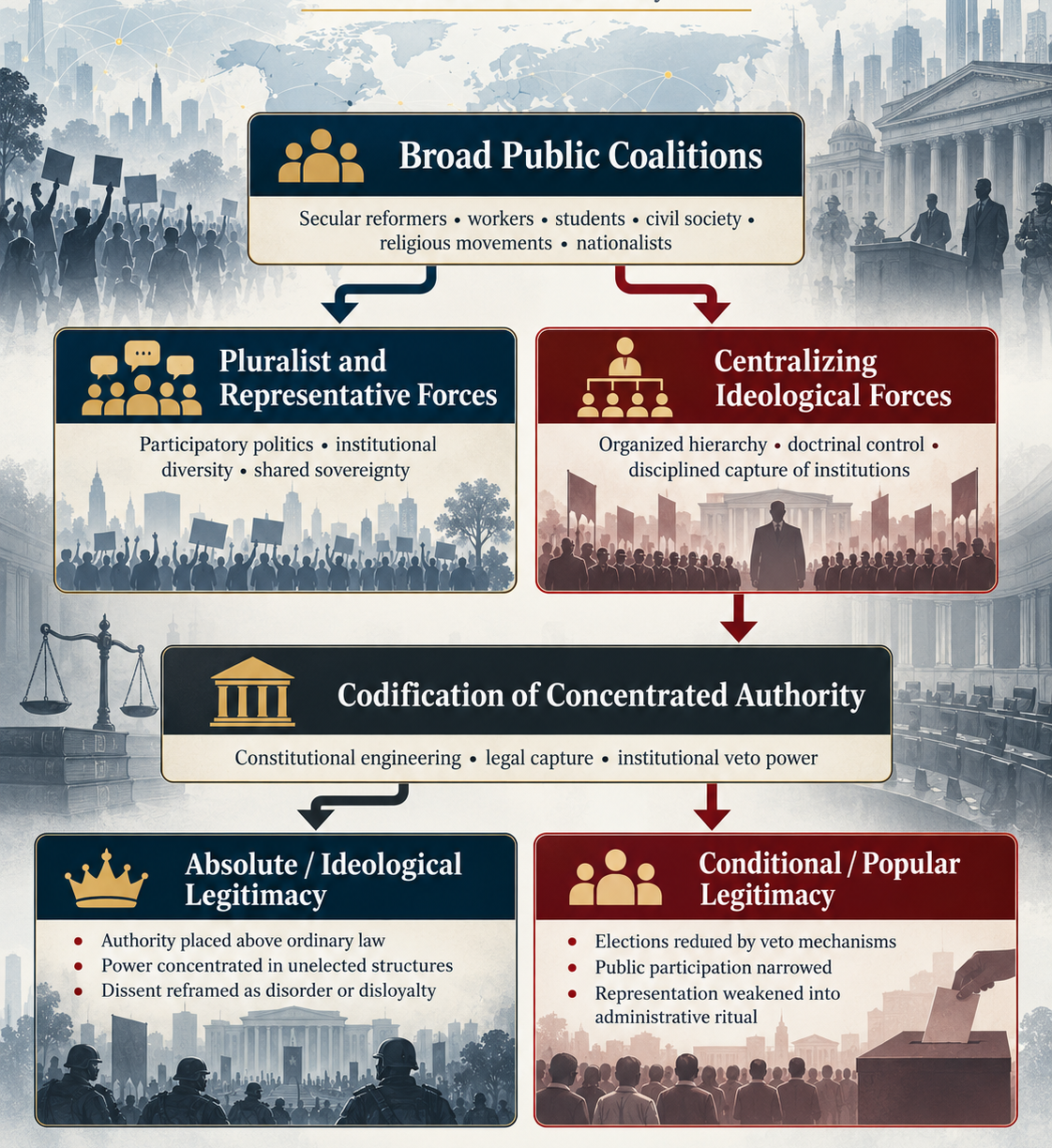
By locating the source of state legitimacy in a divine mandate rather than the popular will, the constitution institutionalized a strict hierarchy. Unelected clerical bodies were placed above elected representative organs.
Consequently, the core principle of political accountability was inverted: instead of the state being accountable to its citizens, the citizens became subservient to the ideological mandates of the state. This constitutional capture laid the groundwork for an enduring autocracy under a religious elite.
Section 2: Velayat-e Faqih and the Decapitation of Popular Sovereignty
Under Articles 57 and 110 of the Constitution of the Islamic Republic, the three traditional branches of government—Executive, Legislative, and Judiciary—do not operate as independent, co-equal powers. Instead, they function under the direct, absolute oversight of the Vali-e Faqih (Supreme Leader) [Iran Constitution]. The inclusion of the word "Motlaqeh" (Absolute) during the 1989 constitutional revisions formally elevated the Leader’s authority above the constitutional text itself. This legalized a meta-constitutional governance model that leaves no room for civic check or balance.
The Architecture of Absolute Command
- Military and Security Monopoly: The Supreme Leader is the Commander-in-Chief of all armed forces. He possesses sole authority over declarations of war or peace, defense mobilization, and the appointment or dismissal of the top commanders of the Islamic Revolutionary Guard Corps (IRGC), the regular Army (Artesh), and Law Enforcement Forces [Iran Constitution].
- Judicial Captivity: The Leader directly appoints the Head of the Judiciary [Iran Constitution]. This individual, in turn, selects all judges and directs the Revolutionary Courts, transforming the justice system into a direct instrument for political suppression and the elimination of domestic dissent [HRW World Report].
- Legislative and Policy Control: Through the Expediency Discernment Council and the Guardian Council—both populated through direct or indirect appointment—the Leader dictates the "General Policies of the System" [Iran Constitution, CFR Power Centers]. This authority effectively overrides bills passed by the elected parliament.
This extreme concentration of power alters the fundamental relationship between the individual and the state. The Islamic Consultative Assembly (Parliament), designed to manifest the popular will, is structurally prohibited from auditing the financial networks, foreign policy initiatives, or security operations directed by the Office of the Supreme Leader (Beyt-e Rahbari). Popular sovereignty is systematically neutralized.
Section 3: The Islamic Revolutionary Guard Corps (IRGC) as a Praetorian State within the State
Founded in 1979 as a counterweight to the conventional military (Artesh), whose loyalty to the new clerical order was initially doubted, the Islamic Revolutionary Guard Corps (IRGC) has undergone a profound transformation. Over four decades, it has evolved into a vast political, economic, intelligence, and military empire [GIF IRGC Profile]. It functions as a praetorian guard that dominates the domestic arena while operating outside civilian oversight.
| Domain | Institutional Mechanisms | Systemic Function |
|---|---|---|
| Military & Strategic | • Asymmetric warfare dominance • Controls ballistic missile/drone arsenals • Manages the external Quds Force |
Projecting regional power and conducting proxy warfare beyond Iran's borders [CRS Report]. |
| Economic Empire | • Khatam al-Anbiya Construction Headquarters • Ownership of telecom, energy, and logistics sectors • Monopolized maritime ports |
Generating off-budget, unaccountable revenue to insulate the regime from international sanctions [FDD IRGC Financials]. |
| Intelligence & Domestic Control | • IRGC Intelligence Organization (SAS) • Direct command over the Basij Paramilitary |
Bypassing civilian ministries to suppress labor unions, student organizations, women's movements, and dissidents [GIF IRGC Profile]. |
The IRGC's relationship with the Supreme Leader has created a self-sustaining power center. The IRGC provides the brute force and financial resources required to sustain the theocracy, while the Leader provides the ideological and legal cover that shields the IRGC from domestic auditing and democratic accountability [FDD IRGC Financials].
Section 4: The Closed Loop of Unelected Institutions and Electoral Engineering
Power preservation in the Islamic Republic relies on a closed loop of self-reproducing, unelected institutions [CFR Power Centers]. These bodies form an institutional wall designed to filter out authentic political representation or reformist initiatives.
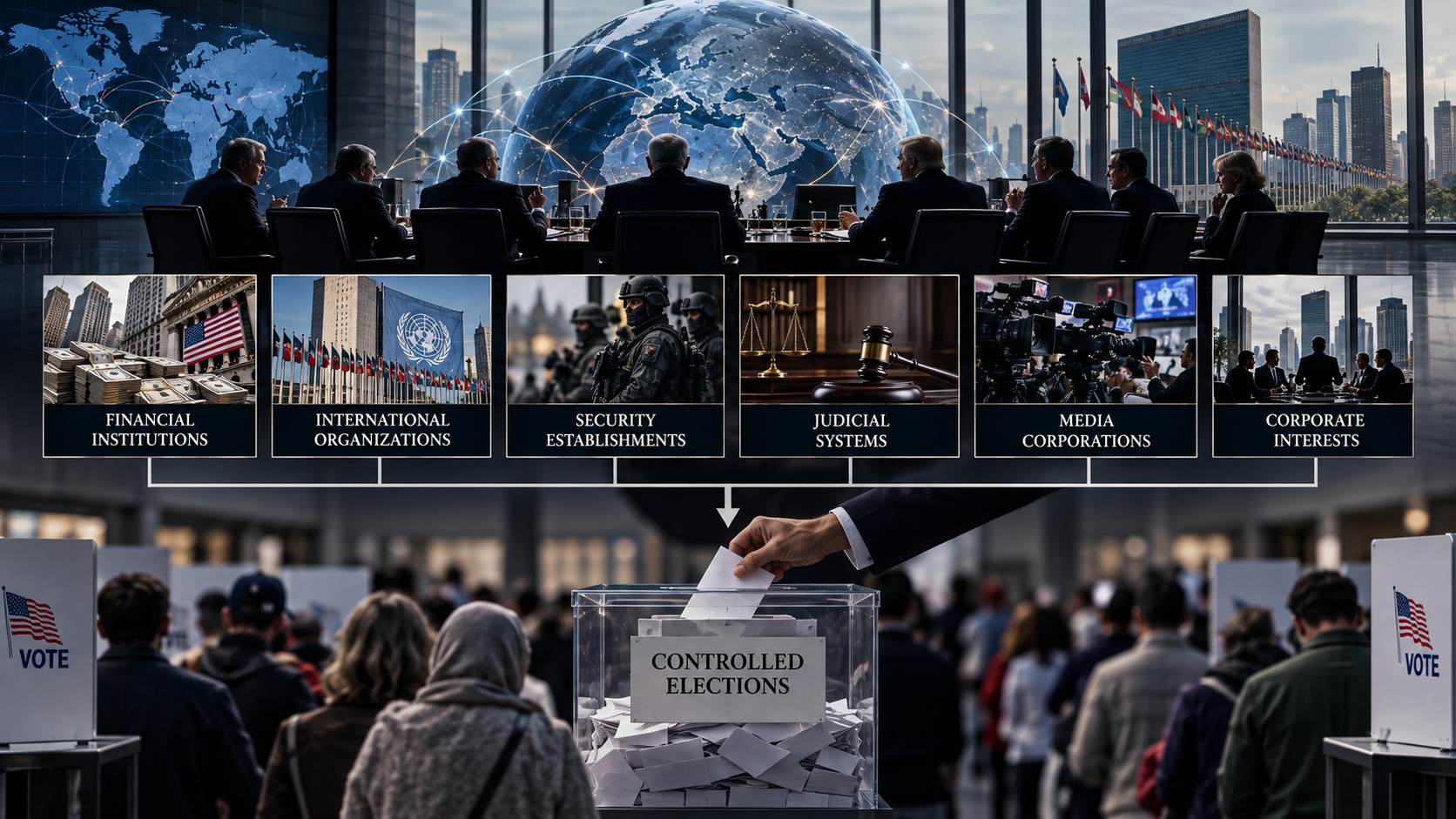
- The Guardian Council (Shora-ye Negahban): Composed of six Islamic jurists appointed directly by the Supreme Leader and six lawyers selected by the judiciary chief (who is also a presidential/Leader appointee) [Iran Constitution]. The Council utilizes Approbatory Supervision (Nezarat-e Estesvabi) to disqualify any candidate for president, parliament, or the Assembly of Experts who does not display total submission to the Supreme Leader [CFR Power Centers]. This practice reduces elections to internal bureaucratic selections among regime loyalists.
- The Assembly of Experts (Majles-e Khobregan): Nominally tasked with electing, supervising, and—if necessary—dismissing the Supreme Leader [Iran Constitution]. However, because all candidates must first be approved by the Guardian Council, the Assembly is filled with the Leader's sycophants. This creates an institutional loop where the Leader indirectly selects the very individuals tasked with monitoring him.
- The Expediency Council (Majma-ye Tashkhis-e Maslahat): A non-elected body appointed entirely by the Supreme Leader [Iran Constitution]. While originally intended to arbitrate disputes between parliament and the Guardian Council, it has evolved into a shadow legislative house that blocks any progressive or reformist laws passed by popular representatives [CFR Power Centers].
Section 5: The Exploitation of Clerical Networks and the Crisis of Religious Legitimacy
To manufacture legitimacy, the regime has systematically nationalized, subsidized, and bureaucratized the Shia religious establishment. This state capture of faith operates through several primary vectors:
- The Bureaucratization of the Clergy: Independent religious schools (Hawzas) in Qom and Mashhad have been integrated into the state apparatus. By funding these institutions and allocating vast budgets to state-aligned clerics, the regime transformed them into ideological functionaries. Dissenting, traditional, or quietist senior clerics who advocate for the separation of religion and state are systematically silenced, placed under house arrest, or tried by the Special Clerical Court—an extrajudicial tribunal answering directly to the Supreme Leader.
- Ideological Polarization via State Media: The Islamic Republic of Iran Broadcasting (IRIB), whose chief is appointed by the Leader, holds an absolute monopoly on domestic broadcasting. It utilizes religious rhetoric to split the populace into binaries: the pious loyalist (Momen) versus the Westernized subversive (Monafeq or Kafir).
- The Boomerang Effect: The instrumentalization of faith to justify economic mismanagement, structural corruption, and political violence has produced a profound societal backlash. Instead of sacralizing the state, this policy has desacralized religion within Iranian society. Contemporary Iran exhibits rapid rates of secularization and religious disaffiliation, converting the regime's primary source of ideological glue into its sharpest social fault line.
Section 6: The Cleavage of the Theocracy: Rhetorical Egalitarianism vs. Oligarchic Corruption
The 1979 Revolution drew significant support from its promises of social justice, its pledge to champion the downtrodden (Mostazafan), and its critiques of Western-allied capitalism. However, the economic architecture of the Islamic Republic has evolved into an insular, oligarchic form of state capitalism.
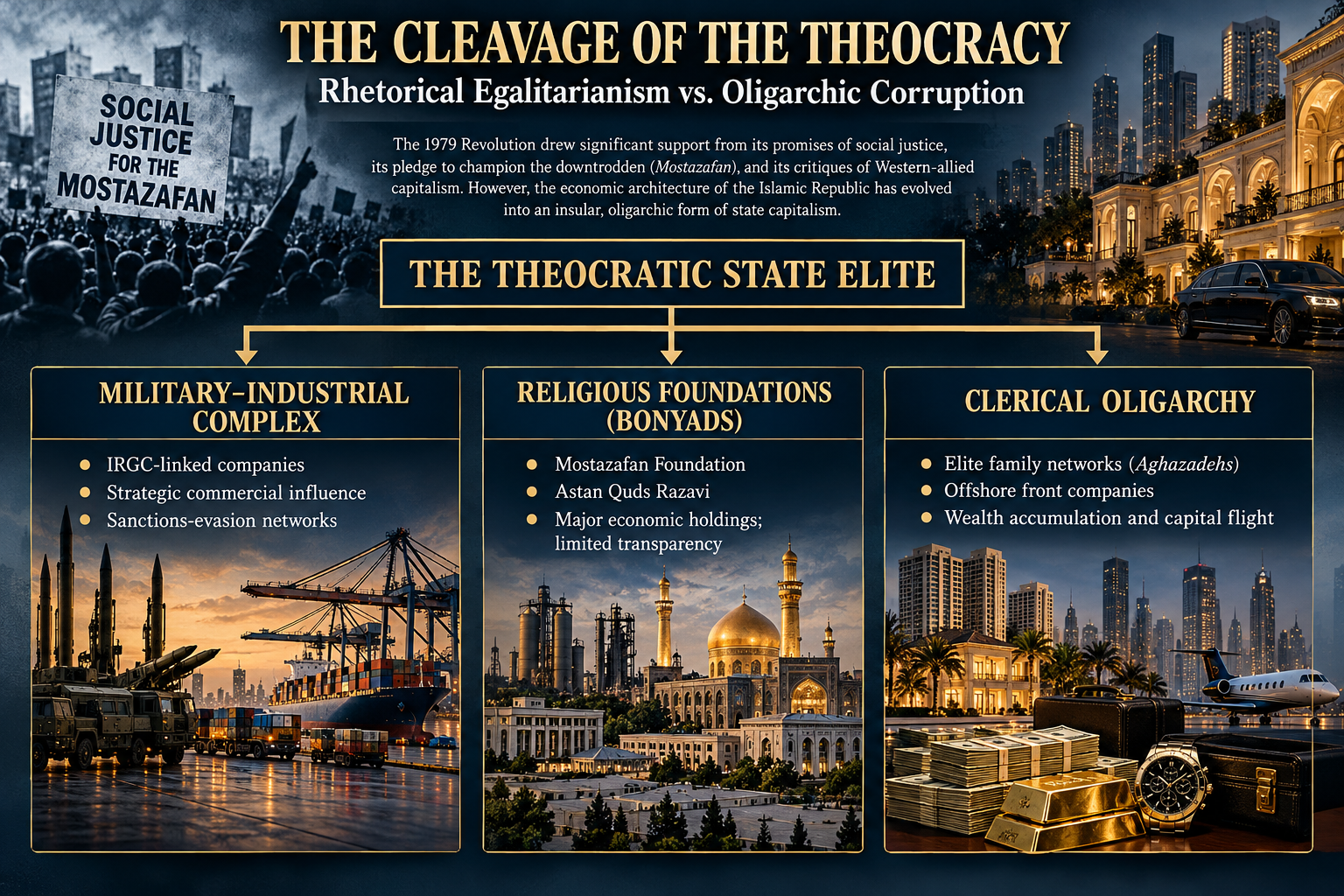
This kleptocratic structure is driven by three main pillars:
- The Bonyads (Parastatal Foundations): Entities like the Foundation of the Oppressed (Bonyad-e Mostazafan), Execution of Imam Khomeini's Order (EIKO), and the Astan Quds Razavi control massive portions of Iran’s non-oil GDP [GIF IRGC Profile]. These mega-conglomerates answer exclusively to the Supreme Leader, pay zero taxes, and are completely insulated from parliamentary or civilian audits.
- Cronyist Privatization and Insider Exploitation: Under the guise of implementing Article 44 of the Constitution (privatization), state-owned assets over the last two decades were not transferred to an open market. Instead, they were sold at artificially low prices to IRGC cooperatives, parastatal foundations, and well-connected regime insiders (Khodi-ha) [RAND Corporation Study].
- The Emergence of the "Aghazadeh" Class: This systemic corruption has birthed a hereditary oligarchy. While the general population faces high inflation, a collapsing currency, and declining living standards, the children of the ruling elite—popularly known as Aghazadehs—exploit preferential state currency exchange rates, import monopolies, and public funds to sustain luxurious lifestyles, often exposing the deep hypocrisy of the regime's anti-Western rhetoric.
Section 7: Ideological Hegemony and Indoctrination in the Educational Sphere
Recognizing that its survival depends on controlling the intellectual development of its youth, the regime launched a comprehensive campaign to restructure higher education and public schooling. This ideological conditioning relies on three main instruments:
- Curricular Revisionism: Textbooks from primary school through higher education are systematically altered to promote an engineered, state-sanctioned historical narrative. This narrative emphasizes martyrdom culture (Shahadat-talabi), absolute obedience to the Jurist, structural anti-Western sentiment, and the mandatory subjugation of women via strict hijab and gender roles.
- Ideological Surveillance and Vetting (Gozinesh): Admission to higher education, employment in public sectors, and promotions for faculty are subject to strict vetting of political and religious beliefs. University campuses are heavily monitored by parallel organizations, including the Supreme Council of the Cultural Revolution, the Office of the Representative of the Supreme Leader in Universities, and student Basij cells.
- The Failure of Indoctrination: Despite investing immense resources into this project, the regime's cultural hegemony has largely collapsed. Access to global satellite television, the internet, and social media networks has insulated younger generations from state propaganda. Iranian schools and universities have transformed into key arenas of resistance, anti-regime mobilization, and defiance against forced religious norms.
Section 8: Foreign Policy Driven by Ideology: The Costs of Exporting the Revolution
The foreign policy of the Islamic Republic prioritizes Pan-Islamist ideological expansion over conventional, nation-state diplomacy. Guided by the constitutional mandate to support liberation movements worldwide, Tehran treats geographic borders as secondary to its global ideological objectives.
This strategic framework operates through several key mechanisms:
- The Axis of Resistance (Mehvar-e Moghavamat): Iran has spent billions of dollars establishing, training, and supplying an expansive network of non-state proxy forces across the Arab world, including Hezbollah in Lebanon, the Houthis in Yemen, and various militias in Iraq and Syria [CRS Report]. This asymmetric network is designed to establish regional dominance and provide strategic depth against its adversaries, primarily Israel and the United States.
- The Sacrificing of National Prosperity: This ideologically driven stance has caused immense damage to Iran's national economy. The pursuit of an unmonitored nuclear program, paired with regional interventionism, has triggered waves of international sanctions [CRS Report]. These measures have isolated Iran from global financial networks (such as SWIFT), halted foreign direct investment, and induced chronic capital flight.
- Subverting the Nation-State: The core tragedy of Iran's foreign policy is the systematic sacrifice of national interests—such as economic growth, regional cooperation, environmental management, and passport credibility—for the preservation of an asymmetric, trans-national ideological network that benefits only the ruling regime's survival.
Section 9: Religious Radicalism, Systematic Repression, and Human Rights Abuses
Religious extremism forms the legal and operational core of the Islamic Republic’s security apparatus. The state uses strict, fundamentalist interpretations of Islamic jurisprudence to codify systematic human rights violations into its penal and civil codes.
- Structural Discrimination and Apartheid: The legal framework enforces systematic discrimination against women, who are legally treated as minors in matters of inheritance, child custody, international travel, and bodily autonomy (manifested in forced hijab laws) [UN OHCHR Portal]. Furthermore, recognized religious minorities face systemic exclusion from senior state posts, while unrecognized groups, particularly the Baha'is, are denied higher education, property rights, and face active persecution [UN OHCHR Portal].
- The Judicial Weaponization of Faith: Broad, ambiguously defined theological offenses are frequently deployed to eliminate political opposition. Charges like Enmity against God (Moharebeh), Spreading Corruption on Earth (Mofsed-e-filarz), and Armed Rebellion (Baghi) carry the death penalty [HRW World Report]. These charges are routinely leveled against political activists, journalists, human rights defenders, and labor organizers after summary trials in Revolutionary Courts, which rely heavily on forced confessions extracted under physical and psychological torture [Amnesty Criminal Justice].
- The Architecture of Street Terrorism: The enforcement of ideological compliance relies on a network of formal and informal security entities. The Guidance Patrols (Gasht-e Ershad), the Basij militia, and plainclothes security agents (Lebas-Shakhsi-ha) carry out continuous surveillance and direct violence against citizens, justifying their actions under the Islamic principle of "Commanding the Right and Forbidding the Wrong." This apparatus has resulted in mass casualties during public crackdowns [Wikipedia Tracker].
Section 10: Strategic Blueprints for a Democratic Transition
The systemic rigidity of the Islamic Republic proves that the regime is incapable of structural self-reform. Because its legitimacy is based on a divine claim, any concession to popular democracy threatens its entire institutional foundation. Therefore, a meaningful transition requires a comprehensive, democratic overhaul that dismantles the existing theocratic system and replaces it with a secular, constitutional democracy grounded in the rule of law and universal human rights.
========================================================================================
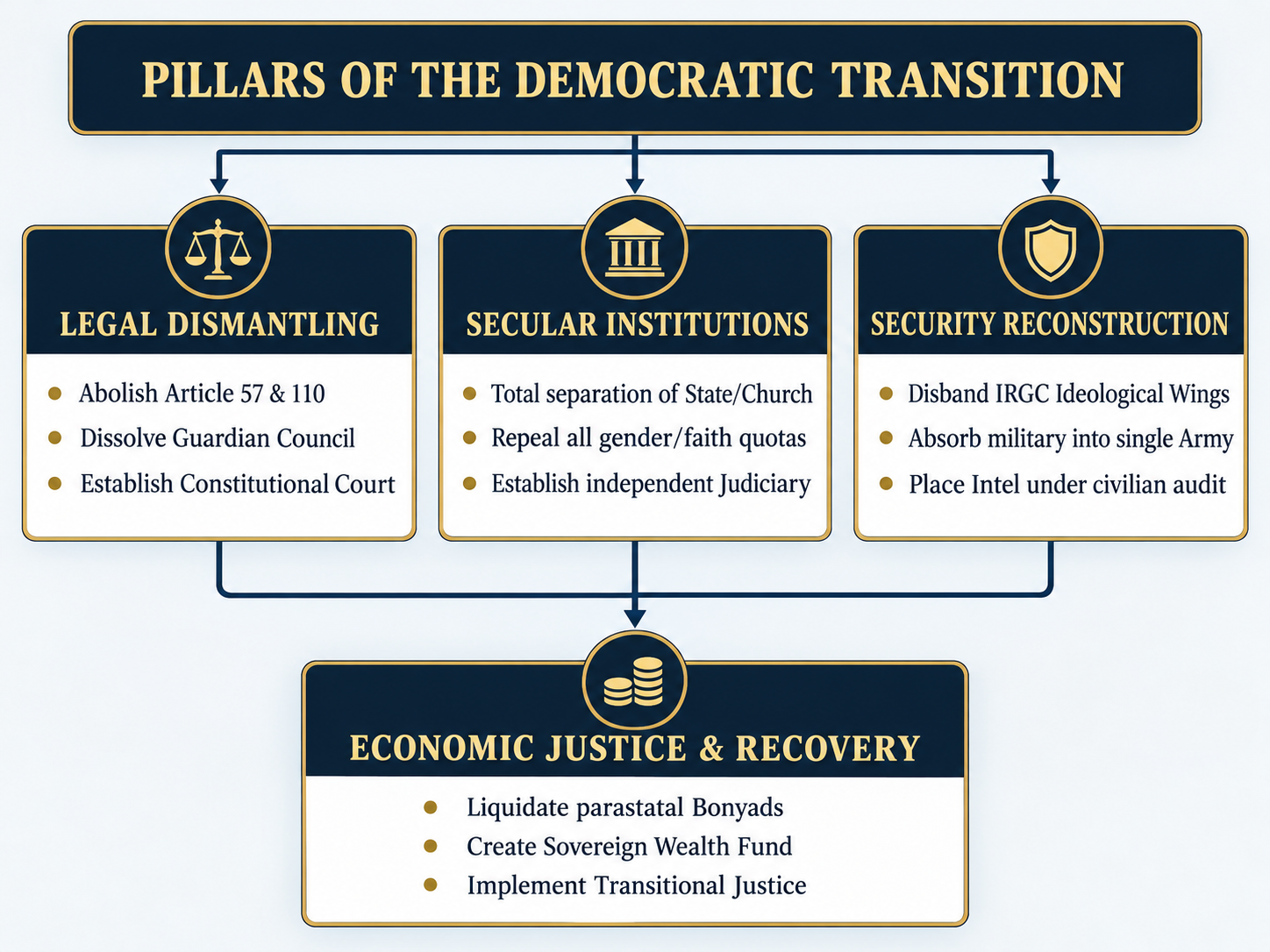
1. Constitutional Refoundation and Institutional De-Theocratization
- Abolition of Clerical Rule: Complete deletion of the Velayat-e Faqih framework from the constitutional matrix. The Office of the Supreme Leader must be permanently abolished, with all executive and military authorities transferred to an elected, accountable civilian administration.
- Dissolution of Ideological Veto Bodies: Permanent dismantling of the Guardian Council, the Assembly of Experts, and the Expediency Council.
- Establishment of a Constitutional Court: Replacing the Guardian Council with an independent Constitutional Court staffed by secular jurists. This court will ensure that all laws passed by an elected parliament comply with international human rights treaties, protecting minority and individual rights from majoritarian or religious overreach.
2. Institutionalizing Political Secularism
- State Neutrality Toward Religion: Establishing strict state neutrality toward all faiths and philosophies. Religion must be decoupled from public administration and moved entirely to the private sphere.
- Modernization of the Legal Codes: Total repeal of the Islamic Penal Code and its replacement with a modern civil and penal framework based on universal human rights. This includes the complete removal of gender-based discrepancies, the decriminalization of lifestyle choices, and the elimination of capital punishment for political or ideological dissent.
- Decoupling Clerical Funding: Cutting off all public subsidies, tax exemptions, and government allocations to religious seminaries and propaganda organizations. The clergy must function purely as civic and religious associations, relying solely on voluntary donations from their adherents.
3. Security Sector Demilitarization and Restructuring
- Dismantling the Praetorian Guard: Disbanding the political, intelligence, and economic commands of the IRGC. Its conventional, border-defense military personnel should be integrated into a unified, non-ideological National Army (Artesh), which must be constitutionally barred from participating in domestic politics and commercial enterprise.
- Civilian Control over Intelligence: Disbanding all parallel intelligence cells (such as the IRGC-SAS). A single, consolidated National Security Agency must be established under the strict oversight of parliament and the judiciary, focusing exclusively on protecting the state from external threats rather than spying on citizens.
4. Economic Reclamation and Transitional Justice
- Expropriation of Parastatal Conglomerates: Seizing the assets of the un-audited Bonyads, EIKO, and the massive holdings of the Astan Quds Razavi. These assets must be placed into a transparent, professionally managed Sovereign Wealth Fund tasked with rebuilding Iran’s crumbling national infrastructure, restoring environmental systems, and funding public health and education.
- Comprehensive Anti-Corruption Audits: Launching an independent National Fact-Finding Commission to investigate historical asset theft, recover looted capital hidden abroad by regime officials, and prosecute financial crimes through transparent, due-process tribunals.
- Transitional Justice and Human Rights Accountability: Establishing truth and justice commissions to document decades of human rights abuses. This process should focus on exposing state crimes, providing reparations and closure to victims and their families, and ending the culture of institutional impunity, while strictly avoiding retributive violence or arbitrary purges.
Conclusion
The Islamic Republic of Iran stands as a stark warning of the consequences that arise when political authority is fused with rigid religious ideology. By prioritizing ideological expansion and power preservation over the welfare of its people, the regime has triggered deep, systemic crises across its economy, society, and environment.
The resilience of Iranian society—especially seen in recent youth- and women-led protest movements—proves that the population has fundamentally rejected the theocracy's core tenets. Moving toward a secular, democratic government is no longer just an idealistic goal; it is a critical necessity for preserving Iran as a nation-state, restoring its national interests, and reintegrating its people into the global community.
Reference Index
- Amnesty Criminal Justice: Amnesty International. Architects of Crimes Against Humanity to Suppress Protests Must Face Justice. Amnesty International Iran Criminal Justice Report.
- CFR Power Centers: Council on Foreign Relations. Understanding Iran's Power Centers. Council on Foreign Relations Iran Power Centers Analysis.
- CRS Report: Congressional Research Service. Iran: Background and U.S. Policy. U.S. Congressional Research Service Iran Background Report.
- FDD IRGC Financials: Foundation for Defense of Democracies. The IRGC Financial Empire and Sanctions Evasion. Foundation for Defense of Democracies IRGC Financial Report.
- GIF IRGC Profile: Gulf International Forum. The Economic Architecture of the Revolutionary Guards. Gulf International Forum IRGC Profile.
- HRW World Report: Human Rights Watch. World Report: Focus on Iran's Judicial Violations. Human Rights Watch World Report on Iran.
- Iran Constitution: University of Minnesota Human Rights Library. The Constitution of the Islamic Republic of Iran. University of Minnesota Human Rights Library Iran Constitution.
- RAND Corporation Study: RAND Research. The Rise of the Pasdaran: Assessing the IRGC's Role. RAND Corporation Iran Institutional Study.
- UN OHCHR Portal: United Nations Office of the High Commissioner for Human Rights. Special Rapporteur on the Situation of Human Rights in Iran. UN OHCHR Special Rapporteur on Iran Portal.
- Wikipedia Tracker: Wikipedia Contributors. Chronology of Mass Casualties and Public Unrest in Iran. Wikipedia 2025–2026 Iran Massacres Tracker.