
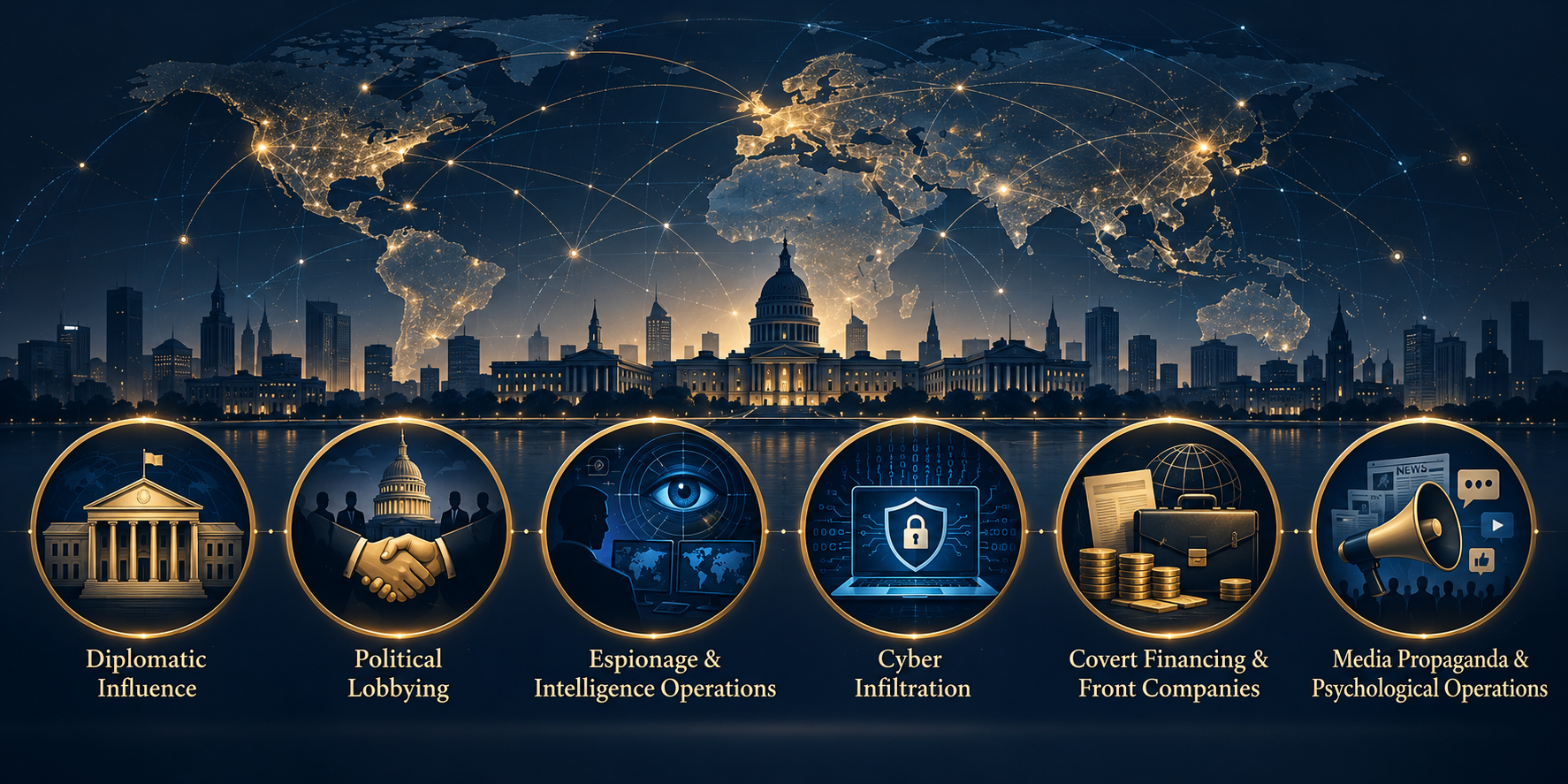
The Islamic Republic of Iran operates not as a conventional nation-state seeking regional stability, but as an ideological, totalitarian kleptocracy, a systematic violator of fundamental human rights, and the premier state sponsor of global terrorism. Rooted in a radical religious-ideological matrix combined with opportunistic left-radical populist rhetoric, the regime considers the subversion of Western democracies and the dominance of the Middle East essential to its survival. This exhaustive investigative analysis dissects the multi-layered architecture of Tehran’s global influence networks—ranging from the weaponization of diplomatic missions to subterranean ballistic fortresses—and exposes critical vulnerabilities within Western consular screening architectures that allow hostile actors to breach domestic borders.
The Weaponization of Diplomatic Immunities: Embassies as Operational Command Posts
The regime’s diplomatic apparatus functions in direct violation of the 1961 Vienna Convention on Diplomatic Relations, systematically repurposing embassies, consulates, and cultural centers into staging grounds for espionage, surveillance, and extraterritorial liquidations. The Ministry of Intelligence and Security (MOIS) and the Islamic Revolutionary Guard Corps (IRGC) utilize diplomatic covers to grant operatives legal immunity, secure communications, and unmonitored logistics.
A definitive legal precedent establishing this state-sanctioned subversion was the conviction of Assadolah Assadi by the Antwerp Court of Appeal in Belgium. Assadi, an accredited diplomat operating out of the Iranian embassy in Vienna, utilized a commercial airliner to transport a high-grade triacetone triperoxide (TATP) explosive device within a diplomatic pouch. The intended target was a massive political opposition rally outside Paris, an operation that would have caused catastrophic mass casualties on European soil.
The Assadi case confirmed that Tehran’s diplomatic installations are directly integrated into the chain of command for foreign terrorist operations. Across Germany, France, Albania, and the United Kingdom, numerous "cultural attachés" and "first secretaries" have been quietly expelled after being identified by counterintelligence agencies as deep-cover MOIS handlers managing networks that monitor Iranian dissidents and Western political infrastructure.
The Triad of Subversion: IRGC, Quds Force, and MOIS
The operational core of the regime's asymmetric warfare consists of three distinct yet synchronized entities, each tasked with breaking Western resolve and projecting regional hegemony:
- The Islamic Revolutionary Guard Corps (IRGC): Designated as a Foreign Terrorist Organization (FTO) by the United States, the IRGC controls vast sectors of Iran’s economy, utilizing billions of dollars in plundered domestic resources to bankroll foreign subversion.
- The IRGC Quds Force (IRGC-QF): Operating as the unconventional warfare arm, the Quds Force specializes in the training, financing, and proliferation of proxy forces across the globe, while simultaneously maintaining sleeper cells within Western metropolitan areas and Latin America.
- The Ministry of Intelligence and Security (MOIS): Focused on domestic repression and international espionage, the MOIS conducts sophisticated cyber-warfare campaigns against Western critical infrastructure, monitors diaspora communities, and contracts transnational criminal syndicates to execute plausible-deniability operations.
By overlapping the jurisdictions of these three organs, the regime ensures operational redundancy.
If a Quds Force cell is compromised by Western counterintelligence, parallel MOIS or IRGC-linked commercial networks can sustain the operation, complicating attribution and tracking for Western agencies.
Technical Deep Dive: The Evolution of MOIS Cyber-Espionage
In its pursuit of digital subversion, the MOIS has dramatically elevated its technical capabilities, evolving into an agile cyber-espionage actor. Rather than operating completely isolated state infrastructure, contemporary MOIS threat actors—predominantly clustered under groups like MuddyWater (Mango Sandstorm) and Void Manticore (the controllers behind the Handala Hack persona)—have structurally integrated themselves into the global cybercrime underground ecosystem.
According to security disclosures from Check Point Research, this weaponized convergence manifests through specialized methodologies:
The MOIS-linked MuddyWater cluster actively leverages custom loader frameworks like CastleLoader and FakeSet to drop its primary implants. To completely bypass Western Endpoint Detection and Response (EDR) agents, these state actors utilize stolen or fraudulently obtained valid code-signing certificates. Once inside a target network, they deploy their Tsundere botnet and DinDoor remote access trojans (written in Node.js and Deno).
Concurrently, the Void Manticore group operates destructive ransomware-as-a-service (RaaS) models, such as the Qilin ransomware, alongside custom disk-wiping payloads. This allows the regime to carry out critical infrastructure strikes under the false guise of simple, apolitical cyber-criminal extortion, effectively clouding state attribution and minimizing direct diplomatic or military repercussions.
The Soft-Power Nexus: Academic Subversion, Think Tanks, and the "Iran Experts Initiative"
To mitigate Western pressure and avert decisive economic or military retaliation, the regime has engineered a sophisticated "soft-power" lobbying ecosystem across Washington, D.C., and European capitals. This network relies on co-opted academics, policy analysts, and non-official intermediaries who populate prestigious think tanks and media outlets.
The clandestine depth of this network was laid bare through investigative disclosures revealing the "Iran Experts Initiative" (IEI). This state-directed project, managed directly by senior officials within Tehran's Ministry of Foreign Affairs, cultivated a ring of high-profile Western analysts. These individuals, while advising Western governments and appearing on global news networks, routinely vetted their op-eds, policy briefs, and conference talking points with Iranian officials.
The primary objective of these echo chambers is to sanitize the regime’s human rights record, frame its aggressive missile and proxy proliferation as mere "defensive posturing," and continuously warn Western policymakers that any robust enforcement of sanctions or support for regime change would lead to a catastrophic regional war.
Jurisdictional Evidences: Western Indictments Formally Branding State-Sponsored Violence
The criminal nature of the regime is thoroughly documented within the judicial archives of Western democracies. The Federal Office for the Protection of the Constitution in Germany (BfV) consistently categorizes Iran alongside Russia and China as one of the top intelligence threats to European security, highlighting its focus on cyber-espionage and industrial technology theft.
In the United States, the Federal Bureau of Investigation (FBI) has unsealed numerous criminal indictments detailing active assassination plots ordered by the IRGC on American soil. These include concrete operational plans to assassinate former high-ranking U.S. national security officials, including John Bolton and Mike Pompeo, as well as brazen kidnapping and murder-for-hire plots targeting Iranian-American journalists like Masih Alinejad in New York City. These legal filings provide forensic proof—including cryptocurrency transaction records, intercepted communications, and confessions from contracted hitmen—demonstrating that the regime utilizes hit squads as an active instrument of its foreign policy.
Corporate Camouflage: The Mechanics of Sanctions Evasion and Terror Finance
The continuous flow of capital required to sustain global terror operations is maintained via a sprawling, non-transparent global financial network. The regime bypasses international banking oversight by establishing thousands of front companies in permissive or highly complex jurisdictions, notably Turkey, the United Arab Emirates, China, and specific East European nations.
According to enforcement documentations issued by the U.S. Department of the Treasury’s Office of Foreign Assets Control (OFAC), these front companies pose as legitimate commercial enterprises dealing in commodities such as petrochemicals, agricultural products, or consumer electronics. In reality, they function as nodes in a massive money-laundering machine.
They commingle the illicit proceeds of smuggled Iranian oil with legitimate trade revenues, using nested bank accounts and obscure hawala networks to move billions of dollars through the international financial system. This capital is subsequently drawn upon by IRGC-QF handlers to fund intelligence operations and purchase dual-use technologies in the West.
Legal Forensic Analysis: Asset Forfeiture Frameworks Against Iranian Shell Networks
Dismantling this corporate matrix requires a rigorous deployment of Western civil and criminal asset forfeiture mechanisms. When an Iranian front company attempts to move capital through the international
financial system, the legal mechanism relies on interlocking statutory authorities. In the United States, this begins when FinCEN Alerts signal suspicious shipping or shadow-banking architectures.
Once OFAC issues a blocking order under the Iranian Transactions and Sanctions Regulations (ITSR), the funds are legally "blocked" within Western correspondent accounts. However, simple blocking leaves the assets in a frozen limbo. To permanently strip the regime of ownership, federal prosecutors launch in rem civil forfeiture proceedings under 18 U.S.C. § 981(a)(1)(G), targeting assets owned by foreign terrorist entities.
A landmark legal standard for this process can be examined via the Transnational Litigation Blog, which explores the litigation of funds tied to Taif Mining Services—a known front company for the IRGC. The federal court affirmed that once OFAC issues a valid clearance license to perfect a forfeiture, financial institutions like Wells Fargo must completely relinquish custody of the funds directly to the U.S. Marshals Service.
Furthermore, under the Expanded Treasury Sanctions Campaigns, any secondary financial institution worldwide that facilitates transaction processing for these shell companies faces complete exclusion from the Western clearing system, creating an effective legal firewall against state-directed money laundering.
Transnational Repression: The Logistics of Kidnapping and Extraterritorial Executions
The regime recognizes no geographical limits to its authoritarian grip, aggressively pursuing, intimidating, and liquidating dissidents far beyond its borders. The historical trajectory of this violence stretches from the 1992 Mykonos restaurant assassinations in Berlin to modern-day state-backed criminal plots.
The United Kingdom's Security Service (MI5) formally disclosed that British intelligence, in coordination with counter-terrorism police, had disrupted over 15 distinct plots orchestrated by the Iranian regime to kidnap or assassinate British citizens or UK-based individuals deemed "enemies of the state".
To obfuscate state responsibility, the MOIS frequently acts as a consumer of services within the international criminal underworld. By outsourcing the physical execution of plots to local organized crime syndicates, Eastern European mafias, or international narcotics cartels (such as the Zindashti syndicate), Tehran seeks to reduce the diplomatic fallout if a cell is intercepted, leaving Western law enforcement to deal with domestic criminals while the state architects remain insulated in Tehran.
Regional Imperialism: The Deconstruction of Sovereignty in the Middle East
Tehran’s regional strategy is built upon the systematic subversion of Arab state sovereignty, replacing centralized governance with a constellation of ideologically aligned, heavily armed non-state actors.
This "Axis of Resistance" serves as a strategic shield for the core regime in Tehran:
- Lebanon: Through Hezbollah, the regime has constructed a parallel state military and political apparatus that effectively holds the Lebanese government hostage, using the country as a forward missile base against Israel.
- Iraq: Following the institutionalization of the Popular Mobilization Forces (PMF), Iranian-backed militias have infiltrated Iraq’s security ministries, steering Baghdad’s foreign policy and systematically threatening democratic factions.
- Syria: By deploying thousands of proxy fighters and direct IRGC assets to preserve the Assad regime, Tehran has secured a permanent land corridor stretching from the Zagros Mountains to the Mediterranean Sea.
- Yemen: By providing advanced anti-ship ballistic missiles, drones, and technical expertise to the Houthi movement, the regime has effectively gained a chokehold over the Bab el-Mandeb strait, threatening global maritime commerce.
Technical Proliferation: Dual-Use Procurement and the Anatomy of Underground Missile Cities
A critical component of Iran’s military capability relies on the systematic theft and illicit acquisition of Western technological innovations. Technical forensic analysis compiled by the Congressional Research Service (CRS) and independent weapons tracking organizations reveals an alarming reality: over 70% of the microelectronics, semiconductor chips, inertial measurement units, and GPS modules extracted from downed Shahed-series kamikaze drones and ballistic guidance systems originate from advanced tech firms based in the United States and the European Union. These components are systematically acquired via multi-layered procurement rings operating under the guise of civilian research or consumer electronics distribution.
Simultaneously, the regime has fortified its strategic arsenal by constructing a vast network of subterranean "missile cities." These underground fortresses are engineered to survive preemptive kinetic strikes and sustain long-term launch capabilities:
These facilities, buried deep within mountain massifs, protect stockpiles of precision-guided missiles and act as independent operational hubs that bypass Western border controls and visa restrictions.
Structural Paralysis: Why the West Fails to Neutralize Tehran's Network
Despite overwhelming intelligence detailing the scope of Iran's hostile operations, Western responses have suffered from chronic structural and political paralysis.
First, the persistent pursuit of diplomatic containment, manifested in repeated attempts to resuscitate failed nuclear agreement, frequently results in the tactical suppression of domestic counterintelligence actions. Western capitals often refrain from freezing front company assets or expelling problematic diplomats to avoid disrupting fragile diplomatic tracks.
Second, the regime exploits the legal protections inherent to liberal democracies. Western judicial systems operate under high evidentiary standards, requiring public, legally uncompromised proof to secure indictments. The MOIS and IRGC exploit this by cloaking their operations within gray-zone
activities, utilizing shell companies, third-party nationals, and ambiguous legal entities that make definitive attribution slow and legally cumbersome.
The Four-Tiered Defense Framework:
A Coordinated Strategy for Western Democracies
To move beyond defensive containment and actively dismantle the regime's foreign networks, Western states must implement an integrated, multi-jurisdictional strategy:
Strict enforcement of Foreign Agents Registration Acts (FARA); mandatory transparency audits for universities and think tanks receiving indirect Middle Eastern funding.
Expose and criminally prosecute covert lobbying entities; purge state-sponsored narratives from policy institutions.
Establishment of a dedicated NATO-level counter-Iran fusion center to pool operational data on IRGC and MOIS movements.
Neutralize sleeper cells, cyber-espionage vectors, and transnational hit squads prior to operational deployment.
Downgrading diplomatic relations to the level of chargé d'affaires; formal closure of non-essential consulates; comprehensive revocation of diplomatic visas for suspicious personnel.
Eliminate the physical infrastructure used as command nodes for state-directed terrorism in Western cities.
Deployment of advanced blockchain analytics to track covert cryptocurrency transfers; total asset forfeiture for non-compliant exchange houses.
Freeze the capital reserves powering illicit front companies and proxy logistics networks.
Consular Border Defense: Transforming the Vulnerable First Line of Security
Within the United States, primary border screening is managed by the Department of Homeland Security (DHS) and U.S. Customs and Border Protection (CBP), working alongside the FBI’s Terrorist Screening Center. In Europe, this falls to Frontex and the Schengen Information System (SIS). However, the absolute first line of defense—the consular visa issuance process overseen by Ministries of Foreign Affairs and the U.S. Department of State—remains critically vulnerable.
The fundamental flaw in current consular operations is the reliance on generalist foreign service officers rather than specialized counter-terrorism, intelligence, and political warfare experts to conduct initial interviews and visa adjudications.
Generalist consular officers are routinely overwhelmed by high applicant volumes and lack the training to detect sophisticated deception techniques, covert operational codes, or hidden institutional ties to the IRGC or MOIS. The regime exploits this administrative gap, funneling highly trained intelligence assets,
cyber-warfare operatives, and dual-use procurement agents through standard visa channels disguised as benign graduate students, corporate executives, or academic researchers.
Advanced Consular Interrogation and Digital Verification Protocols
To prevent hostile infiltration, consular sections must shift from a passive document-review process to an active, intelligence-driven verification framework. Specialized consular officers must deploy advanced screening protocols:
- Deep-Layer Digital Footprint Analysis: Automated cross-referencing of an applicant’s active and deleted digital footprint, including hidden metadata, alternative social media handles, and network connections. This must include checking domestic Iranian state registries—such as national insurance and social security tracking numbers—to unmask hidden employment within military-industrial conglomerates or security ministries.
- Forensic Deconstruction of Military Service: Given mandatory conscription in Iran, every male applicant must undergo detailed tracking to isolate their specific military branch, base location, commanding officers, and technical projects. Anyone with voluntary extensions or specialized service within specialized IRGC technical branches must trigger an immediate, non-appealable visa denial.
- Structured Behavioral Interrogations: Implementing advanced, non-linear interviewing techniques designed by counterintelligence specialists to identify micro-expressions of deception, stress indicators, and scripted cover stories regarding past employment, foreign travel, and financial backers.
Financial Macro-Economics: Restructuring Border Defense Budgets
Western governments allocate immense budgets to domestic surveillance, tactical police responses, and counter-terrorism investigations within their borders. Yet, expanding the funding for frontline consular defense is a far more cost-effective strategy. Expanding the pool of specialized consular officers, deploying real-time biometric and digital verification systems, and enforcing multi-stage security clearings before an individual arrives on Western soil provides an exceptional return on security investment.
The financial and operational strain caused by even a single hostile operative breaching a nation's borders is staggering:
The resource expenditure required to track, monitor, and legally prosecute an entrenched foreign agent far outweighs the upfront cost of comprehensive consular screening. Siloed information systems between ministries of foreign affairs and domestic intelligence agencies must be dismantled, ensuring that real-time biometric data, updated watchlists, and behavioral indicators are available to consular officers globally.
Conclusion
The Islamic Republic of Iran remains an ideological, religious-driven dictatorship, a chronic human rights violator, a crime-centered autocracy, and a state sponsor of terrorism that utilizes left-radical populist strategies to subvert global stability. Its survival is structurally predicated on projecting chaos, initiating aggressive cyber-warfare campaigns, and infiltrating the political, academic, and economic structures of democratic states through untraceable front companies.
Neutralizing this asymmetric threat requires Western democracies to abandon passive policies and implement a proactive strategy focused on advanced technical attribution, aggressive asset forfeiture, and rigorous visa verification protocols. By cutting off illicit capital flows, expelling hostile influence networks, and transforming consular screening into a sophisticated counterintelligence barrier, the international community can safeguard its democratic institutions and protect legitimate refugees fleeing this totalitarian regime.
References
- Office of the Director of National Intelligence (ODNI): Annual Threat Assessment of the US Intelligence Community
- Check Point Research: Iranian MOIS Actors & the Cyber Crime Connection
- US Financial Crimes Enforcement Network (FinCEN): Alert on IRGC Shadow Banking and Oil Smuggling Networks (FIN-2026-Alert002)
- Transnational Litigation Blog: When Are Frozen Assets 'Blocked' Assets Case Analysis
- US Department of the Treasury: Office of Foreign Assets Control (OFAC) Iran Sanctions Resource Center
- Sanctions Compliance Jurisprudence: OFAC, ITSR Compliance & Shell Company Defense Guidelines
- Federal Bureau of Investigation (FBI): Counterintelligence Division State Threats Advisories
- Bundesamt für Verfassungsschutz (BfV): Annual Analysis of Espionage and Cyber Sabotage Activities
- Congressional Research Service (CRS): Iran's Proliferation, Tech Procurement, and Regional Proxy Dynamics
Additional Sources and References
United States Institute of Peace | Conflict Armament Research | El País | Reuters | Noon Post | Iran Experts Initiative | Semafor | Iran International | U.S. Department of Justice | FBI | U.S. Department of Commerce | Defense Counterintelligence and Security Agency