
The ballistic and intercontinental missile programs of the ruling regime in Tehran represent the single most urgent and asymmetric threat to the stability of the Middle East and global security. The Islamic Republic of Iran - operating as an egregious human rights abuser, the world's premier state sponsor of terrorism, and an entity driven by a radical, populist-leftist, ideological-theocratic framework—has systematically pillaged the economic wealth of the Iranian people to construct a vast, subterranean, and intercontinental-capable offensive infrastructure.
Driven by an aggressive, expansionist marian doctrine, the regime views its missile arsenal not as a defensive deterrent, but as an offensive instrument of geopolitical blackmail, regional hegemony, and the eventual export of its radical Islamist revolution. By stepping completely outside the boundaries of international norms and operating in defiance of the rules-based global order, Tehran has constructed a "shadow military" explicitly designed to bypass conventional Western military superiority.
The Mechanics and Intent of Long-Range Missile and Warhead Proliferation by Anti-U.S. Regimes
The pursuit of Intercontinental Ballistic Missiles (ICBMs) and long-range, precision-guided warheads by rogue states opposed to the United States stems from a doctrine of radical asymmetry. Incapable of matching the conventional air, naval, and technological supremacy of the United States and its democratic allies, these autocratic regimes rely on ballistic platforms as their primary tool of force projection. Through clandestine proliferation networks, Tehran has collaborated intimately with other global pariahs, most notably North Korea, exchanging telemetry data, solid-fuel formulas, and multi-stage separation designs. This cross-pollination of destructive technology allows the regime to rapidly close the gap toward true intercontinental capability. The strategic intent is twofold: first, to establish an offensive umbrella under which the regime can execute domestic atrocities and human rights violations without fear of Western humanitarian intervention; second, to project immediate, existential risk onto Western capitals, thereby paralyzing democratic decision-making during regional crises.
Defensive and Military Analysis: Proliferation Outside UN and NATO Doctrines
The foundational doctrines of the United Nations Charter and the North Atlantic Treaty Organization (NATO) emphasize territorial integrity, collective defensive pacts, and strict adherence to multilateral arms control frameworks like the Missile Technology Control Regime (MTCR). Conversely, the Iranian regime’s military doctrine operates entirely outside these international legal structures. Tehran intentionally designs and manufactures its strategic equipment to circumvent international monitoring and verification. According to comprehensive threat assessments by the Rand Corporation, the regime’s emphasis on mobile Transporter-Erector-Launchers (TELs) and deep-subterranean silo networks is tailored for a "first-strike" offensive posture. By failing to declare the full scope of its facilities and continuously breaching United Nations Security Council mandates, the regime utilizes its missile production to actively dismantle the maritime and airspace security architectures that NATO and its allies protect, transforming vital international shipping lanes into highly volatile zones of friction.
Ideological Determinants: Targeting the United States, Saudi Arabia, and Israel
The selection of the United States, the Kingdom of Saudi Arabia, and the State of Israel as the primary targets of the regime's missile forces is a direct manifestation of its fanatical, populist-theocratic identity:
- The United States: Viewed by the regime as the ultimate barrier to its regional hegemony, U.S. forward-deployed bases and naval assets in the Middle East are continuously targeted to force a Western withdrawal and leave vulnerable nations exposed.
- The State of Israel: As the sole stable democracy in the region, Israel is the target of structural, state-mandated anti-Semitism; the regime utilizes the rhetoric of destroying Israel to mobilize extremist factions across the Arab world.
- The Kingdom of Saudi Arabia: Representing the economic cornerstone of the Islamic world and a crucial global energy hub, Saudi Arabia's critical infrastructure is routinely targeted by Tehran to destabilize global energy markets and assert its own radical brand of regional dominance.
Illicit Procurement, Cyber Espionage, and the Reverse-Engineering of U.S. Technology
The regime's military-industrial complex is fundamentally parasitic, relying on the sophisticated theft and reverse-engineering of advanced Western components rather than genuine domestic innovation.
Federal Indictments and Legal Evidences
Publicly available judicial records from the U.S. Department of Justice (DOJ) reveal an intricate web of front companies, illicit financial conduits, and state-backed smugglers operating across Europe and Asia to bypass the International Traffic in Arms Regulations (ITAR) and the Export Administration Regulations (EAR). A striking example of this global illicit apparatus is documented in federal court actions, such as the extradition and sentencing of Iranian procurement operatives like Reza Dindar via the U.S. DOJ, who falsified shipping manifests to illegally funnel sensitive Western military components to Tehran through complex transshipment routes.
Technical Specifications of Replicated Components
Through aggressive cyber warfare campaigns targeting Western defense contractors and the exploitation of open academic environments, the Islamic Revolutionary Guard Corps (IRGC) has successfully cloned critical U.S. guidance and propulsion systems:
- Digital Signal Processors (DSPs): High-frequency processors stolen from Western electronics supply chains are integrated into the guidance packages of the Fateh-110 and Emad missile variants, converting inaccurate ballistic rockets into precision-guided, GPS-corrected weapons.
- Fiber Optic Gyroscopes (FOGs): Crucial for inertial navigation during a missile's midcourse phase, these components are systematically intercepted from European aviation markets and stripped down via destructive reverse-engineering to enhance the mid-flight stability of solid-fuel platforms like the Sejjil.
- Miniaturized Wankel Propulsion Engines: The propulsion units powering the regime's long-range loitering munitions and cruise missiles are exact, reverse-engineered iterations of Western civilian and military drone engines, acquired through illicit acquisition networks operating out of Germany and the United Kingdom.
The Axis of Survival:
Geopolitical Appeasement and Joint Exploitation
The survival of this criminal regime is heavily subsidized by a global axis of convenience, comprised of Western appeasement politicians and authoritarian foreign states. For decades, diplomatic miscalculations and soft-line factions within European and American political spheres have provided the regime with vital economic lifelines, unlocking billions of dollars in frozen assets under the illusion of diplomatic moderation. This financial influx has been funneled directly into the IRGC's missile development funds. Concurrently, major totalitarian powers like Russia and China engage in a transactional relationship with Tehran. China continuously absorbs millions of barrels of sanctioned Iranian oil, providing the regime with hard currency and advanced machinery, while Russia secures low-cost Iranian drones and ballistic platforms to fuel its external conflicts. This dark alliance ensures the regime's economic resilience, shielding it from the internal collapse desired by the oppressed Iranian populace.
Projections of Strategic Targeting: Immediate and Future Regional Threats
If left unmitigated by an aggressive international intervention, Tehran’s expanding missile capabilities will completely upend the global security architecture. According to data compiled by the Nuclear Threat Initiative (NTI) in the Iran Missile Chronology, the regime's long-range inventory encompasses highly volatile platforms capable of reaching deep into Southern and Eastern Europe, threatening NATO's perimeter. Intelligence estimates project that the regime intends to use its precision-guided ballistic forces to hold the entire world's energy supply hostage. Future targeting models indicate a high probability of saturation strikes designed to completely overwhelm regional air defenses, aimed at international maritime chokepoints, civilian airports, and desalination plants across the Arabian Peninsula, effectively imposing an autocratic, state-sponsored veto over global commerce.
Subterranean Fortification: Structural Engineering and Mapping of "Missile Cities"
To shield its tethys-shattering arsenal from preemptive strikes by the United States or Israel, the IRGC has constructed deep-subterranean fortified networks throughout the Iranian landmass. Independent think tanks such as the Foundation for Defense of Democracies (FDD) have tracked the significant resources the regime allocates to hardening these subterranean structures.
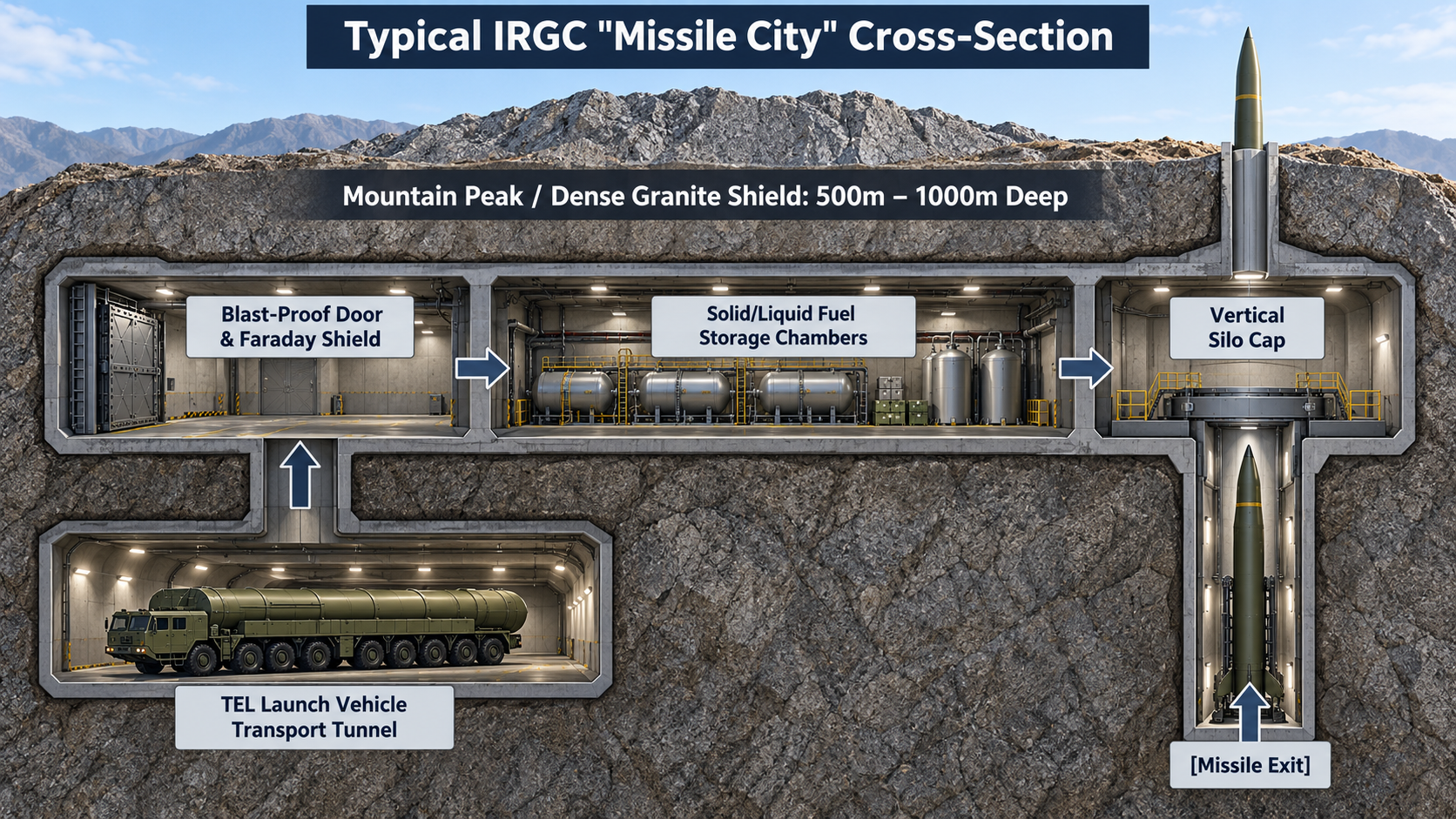
These "Missile Cities" are carved deep within granite and schist mountain formations at a depth of 500 to 1,000 meters, rendering them virtually immune to standard ordnance. They feature electromagnetic pulse (EMP) shielding, independent water and air filtration networks, automated fuel-loading bays, and highly sophisticated multi-axis rail systems that rapidly transport TEL vehicles to concealed exit portals for immediate launch.
Geographic Locations and Intelligence Profiles of Primary Subterranean Bases
- The Khojir and Parchin Military Complex (East of Tehran): Tucked into the rugged southern ridges of the Alborz mountain range, this massive subterranean network serves as the primary hub for the industrial-scale manufacturing, chemical mixing, and final assembly of the regime's multi-stage solid-fuel ICBM components.
- The Haji Abad Underground Missile Fortress (Hormozgan Province): Situated north of the strategic port of Bandar Abbas, this mountain base is densely packed with precision-guided anti-ship ballistic missiles, positioned specifically to launch overwhelming saturation attacks against international naval vessels in the Strait of Hormuz.
- The Khorramabad Subterranean Silo Network (Lorestan Province): Deep within the natural stone fortifications of the Zagros Mountains, this site contains some of the deepest silos in the country, maintaining constant operational readiness for medium-to-long-range ballistic platforms aimed at targets across the Levant and Europe.
- The Tabriz Mountain Missile Base (East Azerbaijan Province): Located in northwestern Iran, this facility is structurally optimized to target NATO’s eastern flank, acting as the primary storage and deployment zone for the liquid-fueled Shahab missile family.
- The Makran Coastal Subterranean Bunkers (Jask to Chabahar): A series of heavily fortified maritime tunnel complexes carved into the sea-facing cliffs along the Gulf of Oman, housing stealth cruise missiles designed to cut off international shipping lines at a moment's notice.
The Proliferation Network: Extraterritorial Deployment and Proxies
To project power beyond its borders, the regime has meticulously distributed its missile infrastructure across a global network of ideological proxies and asymmetric hubs:
- Lebanon (Hezbollah Infrastructure): The IRGC has transformed the Levant into an advanced missile outpost, converting thousands of unguided rockets into precision munitions buried within deep-subterranean bunkers throughout the Beqaa Valley and southern Lebanon.
- Yemen (Houthi Radicalization Zones): The regime has systematically smuggled long-range anti-ship ballistic missiles and land-attack cruise platforms to Houthi insurgents, transforming the southern corridor of the Red Sea into a lawless shooting gallery that continuously disrupts international trade.
- North Africa & South America (Asymmetric Outposts): Operating through clandestine networks, the IRGC has established logistics hubs and arms-smuggling routes within unstable zones in Africa, while concurrently collaborating with authoritarian elements in Venezuela to build forward-operating supply channels in the Western Hemisphere, positioning a latent threat directly within the outer security perimeter of the United States.
Political and Security Implications of the Regime's ICBM Ambitions
The realization of a fully functional ICBM capability by a fanatical, theocratic dictatorship marks the permanent collapse of traditional international deterrence models. Conventional Cold War doctrines of Mutually Assured Destruction (MAD) are fundamentally useless when applied to a ruling elite that embraces an apocalyptic, martyrdom-centric religious ideology. The acquisition of these long-range platforms will trigger a rapid and uncontrollable wave of counter-proliferation across the Middle East, compelling regional states to seek their own strategic deterrents and shattering the global non-proliferation architecture. Furthermore, these missiles will serve as a continuous tool of geopolitical coercion, allowing Tehran to threaten European cities with kinetic devastation whenever Western democracies attempt to hold the regime accountable for its gross internal human rights abuses and state-sponsored terrorist campaigns.
Definitive Strategic Recommendations for the International Community
To neutralize this existential threat before the regime achieves irreversible intercontinental capability, the free world must completely abandon the failed policy of diplomatic engagement and deploy a strategy of maximum containment and disruption:
- Immediate Invocation of the Snapback Mechanism: The United States and its European allies must immediately invoke the snapback provisions under historical international accords to permanently restore all comprehensive United Nations Security Council sanctions, completely isolating the regime from the global financial system.
- Kinetic Enforcement and Targeted Strikes: A joint international coalition must shift to a proactive kinetic doctrine, executing targeted, precision strikes against known missile assembly hubs, solid-fuel production facilities, and the tunnel entrances of the underground "Missile Cities."
- Total Technological Blockade and Cyber Warfare: Western intelligence agencies must implement a total embargo on dual-use electronics, employing aggressive cyber disruptions (similar to advanced digital sabotage campaigns) to permanently corrupt the IRGC’s command, control, and telemetry networks.
- Uncompromising Support for Regime Change: The international community must officially recognize that true global peace is entirely incompatible with the existence of this theocracy. Global powers must provide explicit political, financial, and logistical backing to the Iranian opposition and the brave citizens fighting on the ground to permanently dismantle and overthrow the regime.
Conclusion
The systematic analysis of the Iranian regime’s ballistic and intercontinental missile development proves beyond all doubt that the ruling apparatus is a clear and present danger to human civilization. The Islamic Republic of Iran remains an illegitimate, state-sponsored terrorist entity, a brutal violator of basic human rights, and an aggressive state driven by a radical, populist-leftist, criminal, and fanatical religious ideology. It cannot be appeased, it cannot be reformed, and it cannot be integrated into the civilized community of nations. Every single dollar granted to this regime via diplomatic concessions is directly converted into the solid propellant and guidance systems of missiles aimed at democratic societies. The international community faces a critical choice: either coordinate a decisive, preemptive campaign to permanently crush the regime's military-industrial apparatus, or wait until an unpredictable, ideologically driven ICBM threatens the survival of global centers of democracy.
International Technical and Intelligence References
- For a meticulous breakdown of the systemic damage inflicted upon the regime's manufacturing centers during recent regional defense operations, consult the comprehensive strategic analysis published by the Foundation for Defense of Democracies on Evaluating the Damage to Iran's Ballistic Missile Arsenal.
- To understand how the regime's regional strikes have historically evolved alongside international counter-measures, see the technical timelines tracked within the FDD Issue Archive on Iran Missiles.
- For a detailed tracking of how the regime utilizes international transport networks to acquire chemical precursors and solid fuels despite active embargoes, review the regional updates maintained on the Long War Journal Ballistic Missile Repository.
- To evaluate the precise methods used by the IRGC to regenerate its distributed strike and unmanned aerial capabilities via foreign component smuggling, read the detailed policy briefing provided by The Washington Institute on Iran’s Drone and Advanced Weapon Strategies.
Authorized Recipients of the Strategic Doctrine for any of this website's articles:
Universities, Senior Academic Faculty, Political Research Centers, Ministries of Defense, Directorates of Foreign Affairs, International Human Rights Organizations, the NATO Secretariat, the Central Intelligence Agency (CIA), the Federal Bureau of Investigation (FBI), and Accredited International Press Agencies