
This section compiles the specific legal judgments, intelligence findings, and financial traces that document the transnational operations of the Iranian regime. The evidentiary record is sourced from Western judicial counter-terrorism files, European intelligence disclosures, and federal treasury investigations.
Judicial Benchmarks and European Criminal Verdicts
The Mykonos Restaurant Assassinations (Germany, 1992)
On September 17, 1992, Kurdish-Iranian opposition leaders were assassinated at the Mykonos Greek restaurant in Berlin. The subsequent five-year judicial investigation by the Berlin Higher Regional Court culminated in a landmark verdict on April 10, 1997. The court issued an official arrest warrant for Iran’s Minister of Intelligence, Ali Fallahian, and explicitly ruled that the assassinations were ordered directly by Iran’s top political leadership. This included the supreme leader and the president, operating through a clandestine "Committee for Special Operations."
The legal case file established that the executioners were a mix of Iranian intelligence operatives and Lebanese Hezbollah assets, proving the operational integration between the state apparatus and its primary proxy. Comprehensive archival documentation of this judicial turning point can be examined via the German Federal Ministry of Justice.
The AMIA Bombing Judgments (Argentina, 1994)
The July 18, 1994, suicide bombing of the Asociación Mutual Israelita Argentina (AMIA) community center in Buenos Aires killed 85 people and injured over 300. Decades of forensic accounting, defector testimonies, and intelligence coordination led the Argentine judiciary to issue Interpol Red Notices for senior Iranian officials. These included former President Akbar Hashemi Rafsanjani, former Minister of Defense Ahmad Vahidi, and Mohsen Rezai.
In a decisive legal development, Argentina’s Federal Chamber of Criminal Cassation ruled that the AMIA bombing, alongside the 1992 attack on the Israeli Embassy in Buenos Aires, constituted a crime against humanity. The court legally defined the Islamic Republic of Iran as a "terrorist state" that planned and funded the operation, executed operationally by its proxy arm, Hezbollah. Detailed legal briefs and international warrants are maintained by the U.S. Department of Justice.
The Assadollah Assadi Bomb Plot Trial (Belgium, 2021)
In February 2021, the Antwerp Court of First Instance sentenced Assadollah Assadi, an accredited Iranian diplomat based at the embassy in Vienna, to 20 years in prison. Assadi was arrested after personally transporting half a kilogram of TATP military-grade explosives and a detonator on a commercial flight from Tehran to Europe. His objective was the bombing of a massive Iranian opposition rally in Villepinte, France.
The Belgian state security service (VSSE) established that Assadi did not act as a rogue agent. The operation was planned, verified, and financed by Iran’s Ministry of Intelligence (MOIS) Internal Security Directorate. This case provided direct judicial proof of the regime utilizing its diplomatic infrastructure, pouch privileges, and embassy staff to execute mass-casualty terrorism within the European Union. Case updates and related counter-espionage framework profiles are hosted by the Belgian Federal Justice Service.
Intelligence Disclosures on Transnational Intimidation Networks
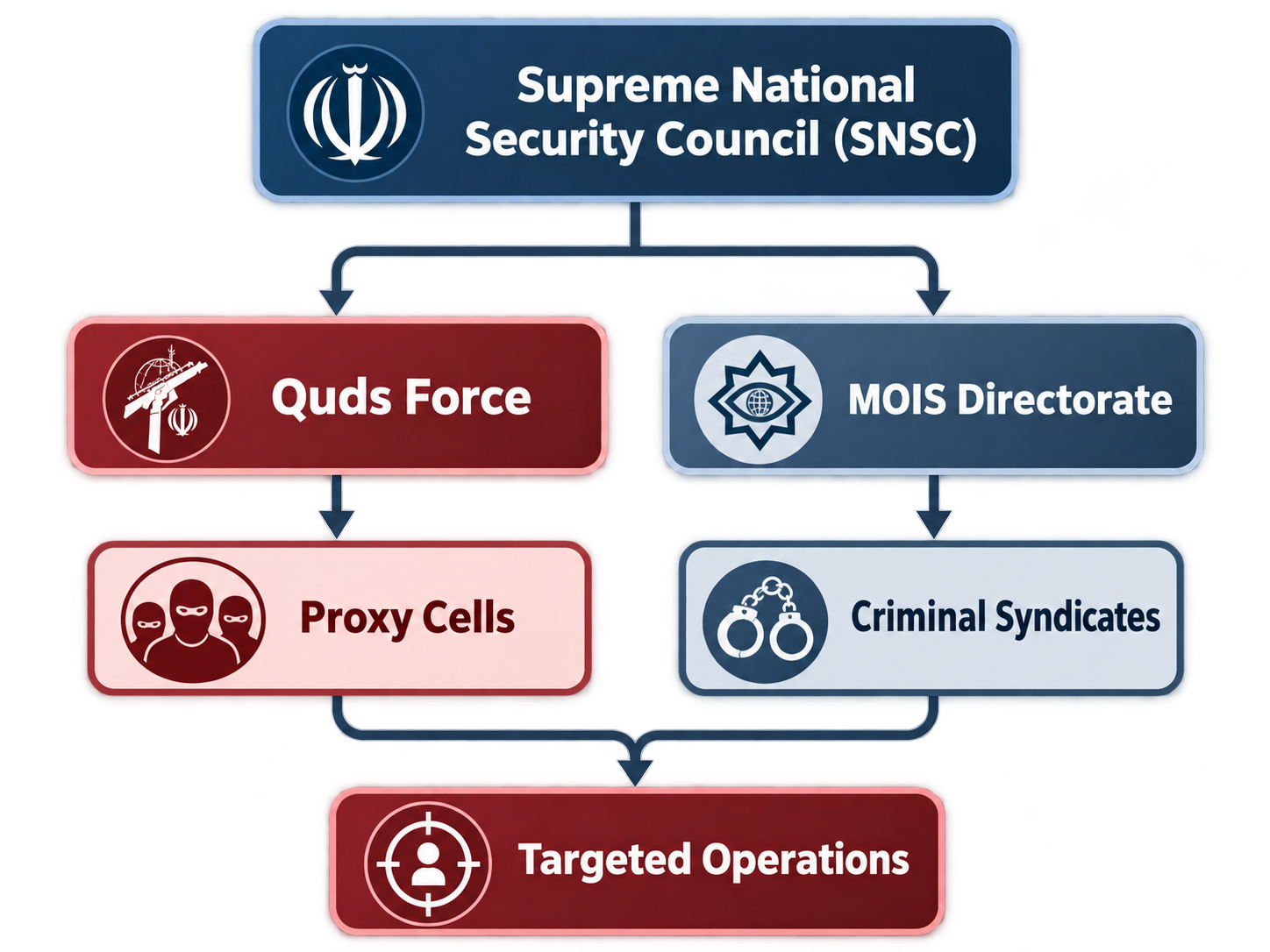
Transnational Repression and Contract Assassinations (United States)
Federal indictments unsealed by the U.S. Attorney’s Office for the Southern District of New York have exposed an operational shift in Tehran’s extraterritorial tactics. Due to heightened Western surveillance on known Quds Force operatives, the regime has systematically outsourced its operational execution to transnational organized crime syndicates.
U.S. judicial records detail the disruption of a plot directed by Iran’s Islamic Revolutionary Guard Corps (IRGC) to assassinate an exiled journalist and political activist on American soil. The network utilized Eastern European criminal networks, specifically the "Thieves in the Law" syndicate, to conduct surveillance and attempt execution.
Furthermore, federal charges exposed a separate IRGC-directed cell targeting former U.S. National Security Advisor John Bolton and other high-ranking defense officials in retaliation for the 2020 elimination of Quds Force Commander Qasem Soleimani. The official indictments and evidentiary exhibits can be retrieved directly from the U.S. Attorney's Office for the Southern District of New York.
European Counter-Espionage Alerts (United Kingdom and Germany)
The UK domestic intelligence service (MI5) and London's Metropolitan Police Counter Terrorism Command disclosed that the Iranian regime directed at least 15 distinct plots to kidnap or assassinate British citizens or UK-based individuals perceived as threats to the regime. These operations specifically targeted independent Persian-language journalists. The threat environment forced emergency relocations of entire broadcasting studios under armed protection.
Concurrently, Germany’s Federal Office for the Protection of the Constitution (BfV) noted a sharp escalation in MOIS-directed espionage targeting Jewish community leaders, Israeli institutions, and Iranian dissidents across Western Europe. These intelligence summaries are detailed in official security briefings available through the UK MI5 Security Service.
Financial Forensics: Corporate Fronts and Illicit Capital Flows
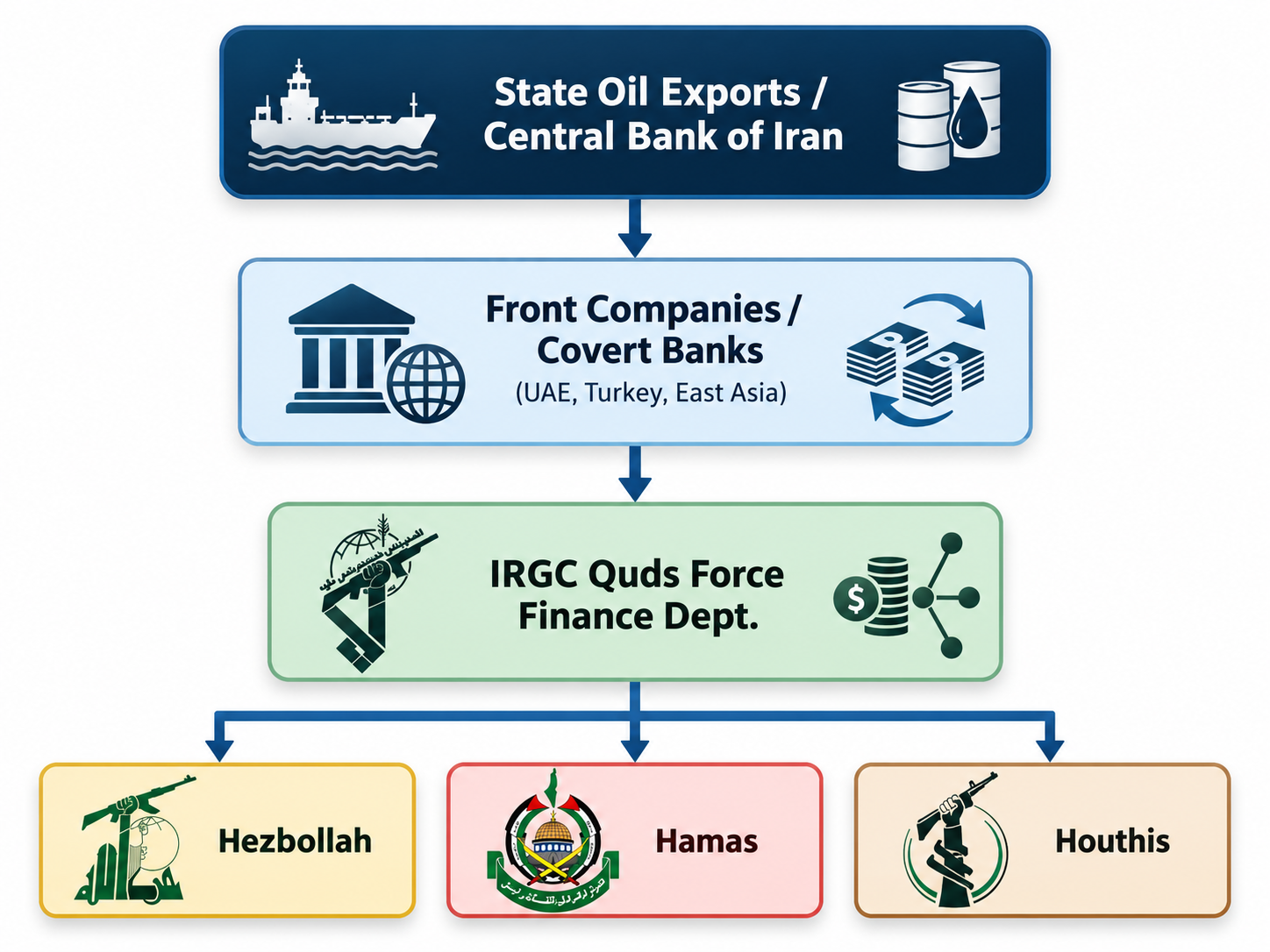
Shadow Banking and the Petro-Terrorism Matrix
The financial architecture underwriting the IRGC Quds Force relies on a global network of shell companies, front entities, and complicit exchange houses designed to evade international AML/CFT controls. According to data compiled by the U.S. Department of the Treasury’s Office of Foreign Assets Control (OFAC), the regime utilizes a network termed the "Shadow Banking System."
This infrastructure obfuscates billions of dollars generated from illicit Iranian oil sales, blending the proceeds into the legitimate international financial stream. Foreign brokers, operating out of jurisdictions in jurisdictions like the UAE, Turkey, and East Asia, register front companies that manage vast fleets of "ghost tankers." These vessels disable their AIS transponders to deliver oil to international markets. The generated liquid capital is routed directly into the operational bank accounts of:
The specific entity designations, corporate registries, and banking transaction maps are documented meticulously by the U.S. Department of the Treasury.
Weaponization of Religious Foundations and Sanctions Circumvention
The regime exploits state-controlled religious and charitable foundations, known as Bonyads, to move capital across international borders without triggering the compliance mechanisms applied to commercial banks. Foundations such as the Mostazafan Foundation and the Astan Quds Razavi operate vast commercial empires spanning construction, agriculture, and manufacturing. Because these entities answer directly to the Supreme Leader, their revenues bypass national legislative oversight.
Financial audits conducted by Western regulators demonstrate that these foundations utilize overseas subsidiaries to procure dual-use technologies, electronics for drone guidance systems, and ballistic missile components, while providing a legitimate corporate cover for undercover Quds Force procurement officers. Analytical breakdowns of these corporate networks are regularly updated by the Office of Foreign Assets Control.
Proliferation of Advanced Asymmetric Weapons Systems
The Houthi Missile and Drone Pipeline (Yemen)
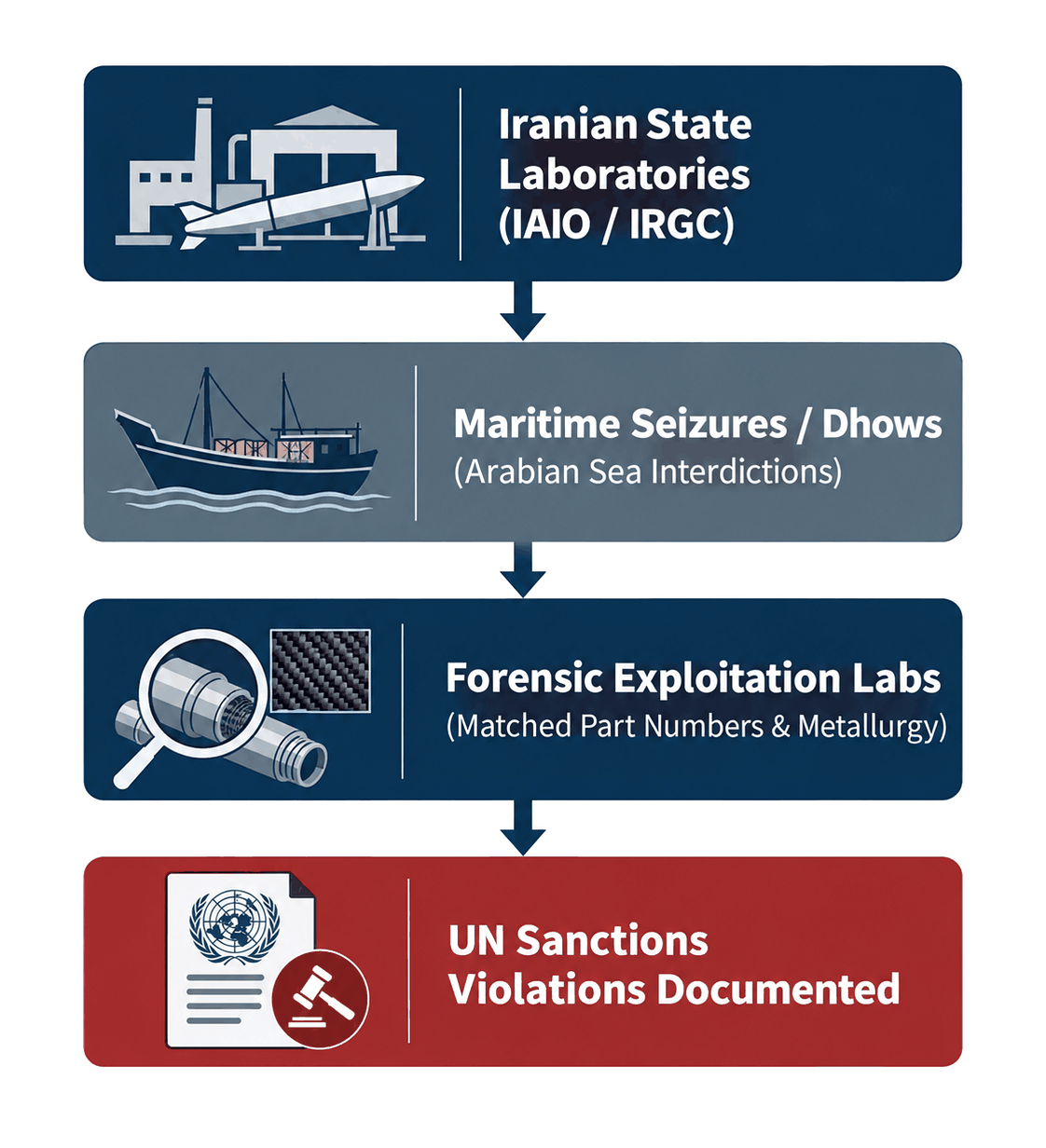
Comprehensive maritime interdictions executed by the United States Navy, the British Royal Navy, and allied French maritime forces in the Arabian Sea have provided physical evidence of Iran’s state-sponsored arms proliferation. Seized dhows have yielded thousands of weapon systems, including:
- Components for the Quds-series land-attack cruise missiles
- Sayyad-series surface-to-air missiles
- Qasef-2K and Samad loitering munitions
The UN Panel of Experts on Yemen has confirmed that the design characteristics, component serial numbers, and carbon-fiber fabrication methodologies of weapons used by the Houthi movement to target commercial shipping in the Bab al-Mandeb strait match those of systems manufactured exclusively by Iran’s Aviation Industries Organization (IAIO) and the Aerospace Force of the IRGC. Technical evaluations and forensic photo logs are available through the U.S. Central Command.
Drone Proliferation in Eurasian Conflict Zones
The transfer of thousands of Shahed-131 and Shahed-136 delta-wing loitering munitions to external actors marks an escalation in Iran's asymmetric projection. Forensic examination of downed ordnance by Western defense intelligence agencies reveals that despite claims of domestic independence, the regime relies on western-manufactured microelectronics sourced through illicit global procurement cells.
This state-managed supply chain funnels high-grade components into the defense manufacturing complexes of Esfahan and Tehran. It underlines the regime’s role as an exporter of instability beyond the Middle East. Comprehensive technical analyses of these weapon transfers are published regularly by the U.S. Defense Intelligence Agency.
International Policy Constraints and Strategic Failure of Enforcement
The Vulnerabilities of Western Counter-Terrorism Frameworks
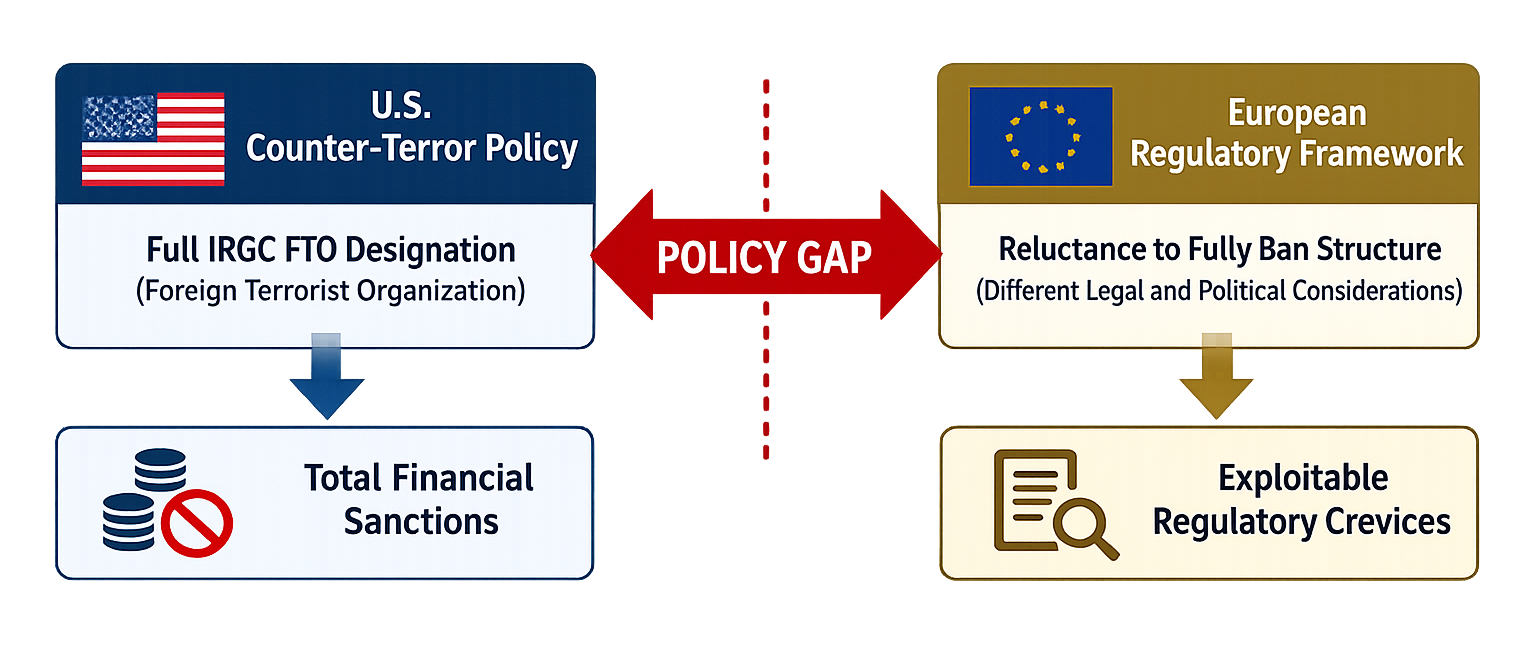
Despite having access to extensive intelligence, Western democratic states face structural, legal, and political obstacles that limit their ability to dismantle Iran’s state-sponsored terror networks. A major gap is the lack of institutional uniformity in designating these entities. While the United States designated the entire IRGC as a Foreign Terrorist Organization, several European jurisdictions hesitated to implement equivalent designations.
This hesitation often stems from strict legal requirements regarding domestic jurisdiction, or a desire to preserve diplomatic channels for potential nuclear negotiations. This lack of policy alignment creates loopholes that allow Iranian front companies to exploit European corporate laws, shield their assets, and manage their logistics.
The Impact of Hostage Diplomacy on Legal Accountability
The regime has developed a systematic policy of "hostage diplomacy" to neutralize Western judicial actions. By arresting Western academics, dual-national tourists, and NGO workers on fabricated espionage charges, Tehran uses these individuals as geopolitical leverage.
This strategy has repeatedly forced Western governments to concede to asymmetric prisoner swaps or release frozen assets. This dynamic was evident in transactions involving the release of convicted Iranian operatives in exchange for Western citizens held in Tehran. This calculated manipulation of Western legal and humanitarian values undermines the deterrence effect of judicial prosecutions, granting Iranian operatives a form of functional immunity when operating abroad.
Framework for Dismantling State-Supported Terror Networks
Strategic Policy Implementations
To counter the asymmetric threats posed by the Iranian regime, the international community must transition from a policy of containment to one of coordinated enforcement. The following measures are necessary to disrupt the regime's operational capabilities:
- Unified Legal Sanctions: European partners must align their legal frameworks with the United States to designate the IRGC in its entirety as a terrorist entity. This would criminalize membership, financial contributions, and logistical support within the European Union.
- Targeted Closures of Diplomatic Assets: Host nations must review the credentials of Iranian diplomatic personnel and close cultural centers or religious trusts that serve as covert operational bases for the MOIS or Quds Force.
- Maritime Enforcement Actions: Allied naval forces must expand their interdiction missions in international waters to intercept illicit arms transfers and disrupt the transport of smuggled petroleum products.
- Global Asset Freezes: Financial regulators must use data from international bodies like the FATF to isolate banks and exchange houses that facilitate the Iranian shadow banking network.
Conclusion
The record of the Islamic Republic of Iran establishes it as a state utilizing terrorism as a primary instrument of its foreign policy. From judicial rulings in European courts to the seizure of military hardware in international shipping lanes, the evidence demonstrates a coordinated effort by the IRGC, the Quds Force, and the Ministry of Intelligence to undermine international security.
The regime's reliance on criminal syndicates, financial front networks, and asymmetric weapons systems shows that its actions are structural rather than incidental. Addressing this challenge requires a coordinated international response that applies legal, financial, and strategic pressure to isolate the regime and dismantle its global infrastructure.
References
- U.S. Department of State - Country Reports on Terrorism: state.gov
- U.S. Department of Justice - Bureau of Counterterrorism Cases: justice.gov
- U.S. Department of the Treasury - Office of Foreign Assets Control: treasury.gov
- UK MI5 Security Service - Counter-Terrorism Intelligence Assessments: mi5.gov.uk
- German Federal Ministry of Justice - Judicial Records Division: bmj.de
- Belgian Federal Justice Service - Antwerp Court Case Records: belgium.be
- U.S. Central Command - Maritime Interdiction and Weapon Forensics: centcom.mil
- U.S. Defense Intelligence Agency - Asymmetric Threat Analyses: dia.mil
- U.S. Department of Justice — IRGC plot targeting John Bolton: DOJ case release
- U.S. Department of Justice — Convictions in plot against a U.S.-based journalist: DOJ court outcome
- U.S. Department of the Treasury — Iran shadow banking network: OFAC enforcement release
- U.S. Department of State — IRGC foreign terrorist organization designation: official designation notice